
Insurance for Rideshare Drivers: What Uber and Lyft Drivers in Cerritos Must Know
Personal auto insurance doesn't cover rideshare driving—here's what coverage you actually need and how to avoid devastating coverage gaps.
AUTO INSURANCEINSURANCE TIPS
Felix | Pinoy General Insurance Services
3/2/20266 min read


If you drive for Uber or Lyft using only your personal auto insurance, you're driving uninsured for significant portions of every shift.
Most rideshare drivers don't realize this until they're in an accident and their insurance company denies the claim because they were "driving for commercial purposes."
Rideshare insurance is complicated because coverage changes depending on which "period" you're in:
Period 0: App is off (personal insurance covers you)
Period 1: App is on, waiting for ride request (coverage gap)
Period 2: Ride accepted, driving to pick up passenger (limited Uber/Lyft coverage)
Period 3: Passenger in car (full Uber/Lyft coverage)
Understanding these periods and how to fill coverage gaps is critical for every rideshare driver in California.
The Coverage Gap That Costs Rideshare Drivers Thousands
What Uber and Lyft Provide
Period 1 (App on, no ride request):
Liability: $50,000 per person / $100,000 per accident / $25,000 property damage
No collision or comprehensive coverage (if you damage your own car, you pay 100%)
Period 2 (Ride accepted, driving to pickup):
Liability: $1 million
Uninsured/underinsured motorist: $1 million
Collision: $2,500 deductible (if you have collision on personal policy)
Comprehensive: $2,500 deductible (if you have comprehensive on personal policy)
Period 3 (Passenger in car):
Liability: $1 million
Uninsured/underinsured motorist: $1 million
Collision: $2,500 deductible
Comprehensive: $2,500 deductible
The Problem: Period 1 Coverage Gaps
When you turn on the app but haven't accepted a ride yet, you have:
✅ Liability coverage (but only $50K/$100K—barely more than California minimum)
❌ NO collision coverage (damage to your car)
❌ NO comprehensive coverage (theft, vandalism, weather damage)
Real scenario: Cerritos Uber driver has app on, waiting for ride request. Gets rear-ended at a red light. The at-fault driver has minimum insurance ($15,000). Uber driver's car has $8,000 in damage.
What happens:
At-fault driver's insurance pays: $8,000 (fortunately, enough to cover damage)
Uber's Period 1 coverage: Not needed this time
Driver's personal insurance: Won't pay (driver was logged into rideshare app)
Now imagine the driver was at fault:
At-fault driver's insurance: $0 (driver was at fault)
Uber's Period 1 collision coverage: $0 (Uber doesn't provide collision in Period 1)
Driver's personal collision coverage: DENIED (commercial use exclusion)
Driver pays $8,000 out-of-pocket
This is the coverage gap that destroys rideshare drivers financially.
What You Need: Rideshare Insurance Coverage
Option 1: Rideshare Endorsement (Add-On to Personal Policy)
What it is: An endorsement added to your personal auto policy that fills Period 1 coverage gaps.
What it covers:
Collision and comprehensive during Period 1 (app on, no ride)
Often includes lower deductibles than Uber/Lyft's $2,500
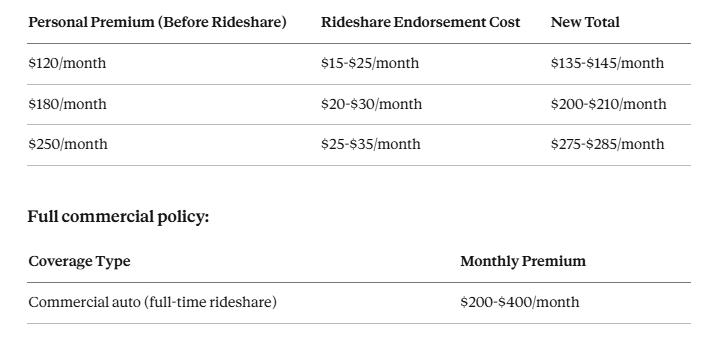
Cost: $10-$30/month additional
Available from:
Mercury
Progressive
Nationwide
Pros:
Fills the Period 1 gap
Often cheaper than commercial policy
Keeps your personal insurance intact
Cons:
Not all carriers offer this
May have limitations on hours driven
This is the best option for most part-time rideshare drivers.
Option 2: Commercial Auto Insurance
What it is: Full commercial coverage designed for rideshare and delivery drivers.
Cost: $200-$400/month (significantly more expensive than rideshare endorsement)
Who needs this:
Full-time rideshare drivers (40+ hours/week)
Drivers who also do food/package delivery
Drivers whose personal carrier doesn't offer rideshare endorsements
Pros:
Comprehensive coverage for all periods
No coverage gaps
Designed specifically for commercial driving
Cons:
Very expensive
May not be cost-effective for part-time drivers
Option 3: Hybrid Approach
What it is: Personal policy with rideshare endorsement + understanding Uber/Lyft's coverage
What you have:
Period 0 (app off): Personal insurance
Period 1 (app on, no ride): Personal insurance + rideshare endorsement
Periods 2-3 (ride accepted/passenger in car): Uber/Lyft insurance + your collision/comprehensive (with $2,500 deductible)
This is what most Cerritos rideshare drivers should have.
What Happens If You Don't Tell Your Insurance Company You Drive Rideshare?
Scenario: You drive for Uber but never told your insurance company. You get in an accident while the app is on.
Possible outcomes:
Best case (very rare):
Your insurance company doesn't find out you were driving rideshare
They pay your claim
You got lucky (but you committed insurance fraud)
Likely case:
Insurance company investigates
Discovers you were logged into Uber app
Denies your claim
You pay for all damages out-of-pocket
Worst case:
Insurance company denies claim
Cancels your policy for material misrepresentation (fraud)
Reports you to other carriers
You're now in the high-risk pool, paying 2-3x normal premiums for years
You may face legal consequences for insurance fraud
Don't hide rideshare driving from your insurer. It's not worth the risk.
How Much Does Rideshare Insurance Cost in California?
Adding rideshare endorsement to existing personal policy:
Factors that affect cost:
How many hours/week you drive
Your driving record
Vehicle type and value
Coverage limits and deductibles
Location (urban areas cost more)
Step-by-Step: How to Get Proper Rideshare Coverage
Step 1: Contact Your Current Auto Insurance Carrier
Call your current insurer and say:
"I drive for Uber/Lyft part-time. I need to add rideshare coverage to my policy. Do you offer a rideshare endorsement?"
If yes:
Get a quote for the endorsement
Understand what it covers (Period 1 gaps, right?)
Add it to your policy immediately
If no:
Ask if they'll still cover you with rideshare driving disclosed
Many carriers will decline to insure rideshare drivers at all
Step 2: Shop Rideshare-Friendly Carriers (If Needed)
If your current carrier doesn't offer rideshare coverage:
Carriers that offer rideshare endorsements:
Allstate (Ride for Hire)
State Farm
Farmers
Progressive
Nationwide
GEICO (varies by state)
Get quotes from at least 3 carriers with rideshare endorsements.
Step 3: Compare Total Cost
Calculate:
Personal premium + rideshare endorsement
vs. Commercial policy cost
vs. Risk of driving uninsured in Period 1
For most part-time drivers: Personal + rideshare endorsement is the most cost-effective option.
Step 4: Purchase and Update Your Rideshare App
Once you have proper coverage:
Upload your new insurance card to Uber/Lyft
Keep proof of rideshare coverage in your vehicle
Notify Uber/Lyft immediately if your policy changes
Understanding the Four Periods of Rideshare Coverage
Period 0: App Off (Personal Insurance Applies)
You're covered by: Your personal auto insurance
What's covered:
Liability
Collision (if you have it)
Comprehensive (if you have it)
No issues here—you're driving for personal use.
Period 1: App On, Waiting for Ride (THE GAP)
You're covered by:
Uber/Lyft: $50K/$100K liability only
Your personal insurance: Maybe (only if you have rideshare endorsement)
What's NOT covered by Uber/Lyft:
❌ Collision (damage to your car if you're at fault)
❌ Comprehensive (theft, vandalism, weather damage)
Without rideshare endorsement:
You're driving uninsured for collision/comprehensive
If you damage your car, you pay 100% out-of-pocket
With rideshare endorsement:
Your personal policy fills the gap
You have full collision/comprehensive coverage
Period 2: Ride Accepted, Driving to Pickup
You're covered by: Uber/Lyft (primary) + your personal policy (excess)
Uber/Lyft provides:
$1 million liability
$1 million uninsured/underinsured motorist
Collision with $2,500 deductible
Comprehensive with $2,500 deductible
Much better coverage, but that $2,500 deductible is high.
Period 3: Passenger in Car
You're covered by: Uber/Lyft (same as Period 2)
Full $1 million coverage for liability and uninsured motorist.
Collision/comprehensive with $2,500 deductible.
Common Rideshare Insurance Mistakes
Mistake #1: Not Disclosing Rideshare Driving
Why it's a problem: Insurance fraud, denied claims, policy cancellation.
Fix: Disclose rideshare driving to your insurer and add proper coverage.
Mistake #2: Assuming Uber/Lyft Coverage Is Enough
Why it's a problem: Period 1 has no collision/comprehensive. You're exposed during wait times.
Fix: Add rideshare endorsement to cover Period 1 gaps.
Mistake #3: Driving Without Checking Coverage Periods
Why it's a problem: You might think you're covered when you're not.
Fix: Understand exactly what's covered in each period and plan accordingly.
Mistake #4: Keeping Collision on an Old Car
Why it's a problem: If your car is worth $3,000 but you're paying $600/year for collision with a $1,000 deductible, you're wasting money.
Fix: Drop collision/comprehensive on older vehicles, save premiums.
Mistake #5: Not Shopping for Better Rates
Why it's a problem: Rideshare-friendly carriers vary significantly in pricing.
Fix: Get quotes from multiple carriers annually.
Tax Deductions for Rideshare Insurance
Good news: Rideshare insurance premiums are tax-deductible business expenses.
What you can deduct:
The portion of your premium attributable to rideshare driving
If you drive rideshare 30% of the time, you can deduct approximately 30% of your premium
Keep records:
Mileage logs (rideshare miles vs. personal miles)
Insurance premium statements
Receipts for all vehicle-related expenses
Consult a tax professional for specific guidance on deductions.
What to Do After an Accident While Rideshare Driving
Step 1: Ensure Safety
Check for injuries
Call 911 if anyone is hurt
Move to a safe location if possible
Step 2: Document Everything
Take photos of all vehicles and damage
Get other driver's insurance information
Get witness contact information
Note which period you were in (app on/off, passenger in car, etc.)
Step 3: Report to Appropriate Parties
If you were in Period 0 (app off):
Report to your personal insurance only
If you were in Period 1, 2, or 3 (app on):
Report to Uber/Lyft immediately through the app
Report to your personal insurance (especially if you have rideshare endorsement)
Step 4: Follow Up
Work with Uber/Lyft's insurance team
Coordinate with your personal insurance if needed
Keep all documentation organized
Final Thoughts
Rideshare driving without proper insurance is a financial time bomb. The coverage gaps are real, and thousands of drivers learn this the hard way every year.
The cost of a rideshare endorsement ($15-$30/month) is minimal compared to the risk of being uninsured during Period 1.
Don't wait until after an accident to fix your coverage. Do it today.
Need help with rideshare insurance?
📞 Call: (562) 402-1737
📧 Email: info@pinoygeneralinsurance.com
📍 Visit: 17304 Norwalk Blvd, Cerritos, CA 90703
🌐 Online: pinoygeneralinsurance.com
We work with multiple carriers that offer rideshare endorsements. We'll help you:
Determine exactly what coverage you need
Compare quotes from rideshare-friendly carriers
Add proper coverage at the best price
Stay compliant with Uber/Lyft requirements
Because one denied claim can cost more than a lifetime of proper coverage.
About the Author:
Felix Lopez is a licensed insurance agent and business development manager at Pinoy General Insurance Services in Cerritos, California. Since 1993, Pinoy General Insurance has been helping Southern California drivers—including rideshare and delivery drivers—secure proper coverage.
Contact Us Today
Contact us here at Pinoy General Insurance Services today for all your insurance needs.
Phone
© 2025 Pinoy General Insurance Services. All rights reserved.