
Key Person Insurance: Protecting Your Business from the Loss of Critical Employees
How key person life insurance protects businesses from financial devastation when critical employees die or become disabled.
BUSINESS INSURANCESPECIALTY INSURANCE
Felix | Pinoy General Insurance Services
3/23/202612 min read


Your top salesperson generates 40% of your company's revenue. She dies unexpectedly in a car accident.
Within three months:
Revenue drops by $500,000
You scramble to hire and train a replacement (cost: $80,000)
Clients leave because of the disruption
Your bank threatens to call your business loan
You're forced to take a salary cut to keep the business afloat
One year later, your business is still struggling to recover. You've lost $800,000 in revenue, spent $150,000 on recruitment and training, and accumulated $200,000 in additional debt.
Total financial impact: Over $1 million.
A $1 million key person life insurance policy would have cost you $2,500/year. Instead, you're facing potential bankruptcy.
This scenario plays out in small businesses across California every year. Most business owners never consider what would happen if their most critical employee—or they themselves—suddenly died or became disabled.
After helping Orange County businesses protect themselves since 1993, I can tell you exactly what key person insurance is, who needs it, how much coverage to buy, and how it can save your business from financial catastrophe.
What Is Key Person Insurance?
Simple Definition: Life insurance owned by a business on the life of a critical employee, with the business as the beneficiary.
How It Works:
Business identifies "key person" - employee whose death would cause significant financial harm
Business purchases life insurance policy on that person's life
Business pays premiums (usually tax-deductible as business expense)
Business is the owner and beneficiary of the policy
If key person dies, business receives death benefit tax-free
Business uses proceeds to:
Replace lost revenue
Recruit and train replacement
Pay off debts
Reassure lenders/investors
Keep business operating during transition
This is NOT the same as:
Personal life insurance (owned by individual, benefits family)
Group life insurance (benefits employees' families)
Buy-sell insurance (funds buyout of deceased owner's shares)
Key person insurance protects the BUSINESS from financial loss when a critical employee dies.
Who Qualifies as a "Key Person"?
A key person is anyone whose death or disability would cause significant financial harm to your business.
Common Examples:
1. Business Owner/Founder
Especially in businesses dependent on owner's expertise, relationships, or reputation
Loss would devastate operations and revenue
Often the most obvious key person
2. Top Sales Producer
Generates significant portion of revenue
Has established client relationships
Would take months or years to replace revenue stream
Example: Sales rep generates $2 million in annual revenue with 20% profit margin = $400,000 in annual profit lost if they die.
3. Specialized Technical Expert
Possesses rare skills or knowledge
Critical to product development or service delivery
Difficult or impossible to replace quickly
Example: Software engineer who built your proprietary system and is the only one who fully understands it.
4. Key Manager/Executive
Manages critical operations
Maintains key vendor/client relationships
Departure would disrupt business operations
5. Creative Talent
Designer, architect, chef, artist whose work defines your brand
Loss would damage brand reputation and client relationships
6. Licensed Professional
Doctor, lawyer, architect, engineer whose license allows business to operate
Loss could prevent business from legally operating in certain areas
Questions to Identify Key Persons:
Ask yourself:
Whose death would immediately impact revenue by 20%+ ?
Who would be extremely difficult to replace within 6-12 months?
Who has relationships with your most important clients?
Who possesses unique knowledge or skills critical to operations?
Whose loss would cause your bank to demand loan repayment?
Who would your competitors try to hire away (if they could)?
If you answer "yes" to 2+ questions for any employee, they're likely a key person.
Real Example - Cerritos Manufacturing Company:
15-employee precision manufacturing business
Key Persons Identified:
Owner (age 58): Client relationships, industry expertise, provides financing guarantee
Lead Engineer (age 52): Only person who understands proprietary manufacturing process
Top Salesperson (age 45): Generates 60% of revenue through long-term client relationships
Risk Assessment:
Owner's death: Bank calls $500K loan, clients leave, business likely closes
Engineer's death: Cannot fulfill existing contracts, $300K+ in lost revenue
Salesperson's death: Lose $1.2M in annual revenue, takes 2+ years to rebuild
Solution:
$1M policy on owner
$500K policy on engineer
$1M policy on salesperson
Total annual premium: $6,200
Total protection: $2.5M
Cost of being uninsured: Potential business closure worth $3-5M.
How Much Key Person Insurance Do You Need?
There's no single formula, but here are three approaches:
Method 1: Multiple of Salary
Simple approach: 5-10x the key person's annual salary
Example:
Key employee salary: $120,000
Coverage: $600,000-$1,200,000
Pros: Easy to calculate Cons: Doesn't account for actual revenue impact or replacement costs
Method 2: Revenue Impact Analysis
More accurate approach: Calculate revenue/profit attributable to key person, multiply by years to replace.
Formula: (Annual revenue generated × Profit margin) × Years to replace
Example - Top Salesperson:
Annual sales generated: $2,000,000
Profit margin: 25%
Annual profit contribution: $500,000
Time to replace and rebuild: 2-3 years
Coverage needed: $1,000,000-$1,500,000
Example - Technical Expert:
Annual revenue dependent on their expertise: $800,000
Profit margin: 30%
Annual profit contribution: $240,000
Time to find/train replacement: 2 years
Additional costs: Recruiting ($50K), training ($30K), interim consulting ($100K)
Coverage needed: $660,000-$750,000
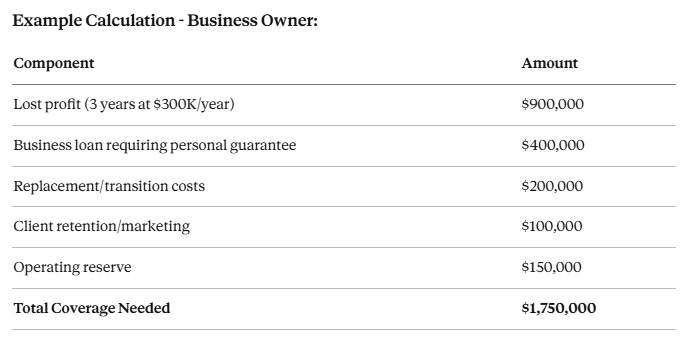
Method 3: Comprehensive Financial Impact
Most thorough approach: Calculate total financial impact of loss.
Components to Include:
Lost Revenue/Profit
Annual profit contribution × years to recover
Replacement Costs
Recruiting fees: $50,000-$150,000 (20-30% of salary)
Signing bonus/relocation: $20,000-$100,000
Training costs: $30,000-$80,000
Reduced productivity during ramp-up: $50,000-$200,000
Debt Coverage
Outstanding business loans that might be called
Line of credit that might be pulled
SBA loans requiring key person guarantee
Opportunity Costs
Lost contracts/bids during disruption
Damaged client relationships
Competitive disadvantage
Stabilization Reserve
Operating capital during transition
Marketing to reassure clients
Retention bonuses for remaining staff
Round to: $1,500,000 or $2,000,000 policy
General Guidelines:
Business Owner: $500,000-$5,000,000 (depending on business size/revenue)
Top Sales Producer: $500,000-$2,000,000
Key Executive: $250,000-$1,500,000
Technical Expert: $250,000-$1,000,000
Specialized Professional: $300,000-$1,000,000
Multiple Key Persons:
If you have 2-3 key persons, you need separate policies on each, OR one large policy that can be split among multiple losses.
Types of Key Person Insurance: Term vs. Permanent
You have two main options:
Term Life Insurance
How it works:
Coverage for specific period (10, 20, 30 years)
Level premiums during term
No cash value
Coverage expires at end of term
Best for:
Temporary key person situations
Budget-conscious businesses
Younger key employees (long coverage period needed)
When you only need coverage while person is employed
Pros:
Much lower premiums (50-70% cheaper than permanent)
Straightforward coverage
Easy to understand
Flexibility to adjust coverage as needed
Cons:
No cash value buildup
Coverage ends (must renew at higher rates)
Premiums increase at renewal
No permanent protection
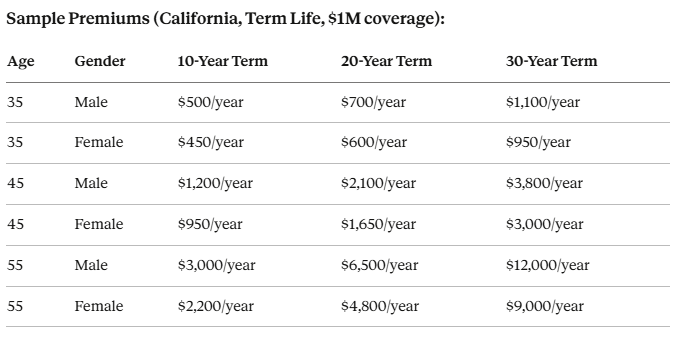
Cost Example:
$1M term policy, 45-year-old non-smoker: $1,200-$1,800/year
Permanent Life Insurance (Whole Life, Universal Life)
How it works:
Coverage for entire lifetime
Premiums build cash value
Can borrow against cash value
Premiums guaranteed or flexible (depending on type)
Best for:
Long-term key person (owner, partner)
Business wanting to build asset on balance sheet
When you want to retain policy after key person leaves
Executive compensation/retention strategy
Pros:
Coverage never expires
Builds cash value (business asset)
Can borrow against cash value for business needs
Can be used as executive benefit/golden handcuff
Cons:
Much higher premiums (2-4x more than term)
More complex
Takes years to build significant cash value
Lower death benefit per dollar of premium
Cost Example:
$1M whole life policy, 45-year-old non-smoker: $8,000-$12,000/year
Which Should You Choose?
Choose Term Life if: ✅ Budget is tight ✅ Need maximum coverage per premium dollar ✅ Key person is not owner (will eventually leave/retire) ✅ Business is young/growing (maximize protection now) ✅ Want simplicity
Choose Permanent Life if: ✅ Key person is owner (permanent need) ✅ Want to build business asset (cash value) ✅ Plan to use as executive compensation ✅ Can afford higher premiums ✅ Want to retain policy after key person transitions out
Hybrid Approach:
Many businesses use BOTH:
Large term policy for maximum protection (e.g., $2M term)
Smaller permanent policy for cash value/long-term coverage (e.g., $500K whole life)
Total coverage: $2.5M with balanced cost
Tax Implications of Key Person Insurance
Understanding the tax treatment is critical:
Premiums:
General Rule: Premiums paid by business are NOT tax-deductible.
Why: IRS considers this personal insurance benefit, not ordinary business expense.
Exception: In rare cases with special structuring, partial deductibility may be available. Consult tax professional.
Death Benefit:
Good News: Death benefit received by business is generally TAX-FREE under IRC Section 101(a).
Requirements for tax-free treatment:
Business is owner and beneficiary
Insured was employee at time of policy issuance
Business notified insured of coverage
Policy was not transferred-for-value
Example:
Business receives $1,000,000 death benefit
Pays $0 federal income tax on proceeds
Can use full $1,000,000 for business recovery
Cash Value:
If permanent policy with cash value:
Cash value grows tax-deferred
Business can borrow against cash value tax-free
Must repay loans with interest or death benefit is reduced
Alternative Minimum Tax (AMT):
Corporate AMT was eliminated in 2018, so death benefits are now fully tax-free for corporations without AMT implications.
Important: Tax laws change. Consult CPA or tax attorney for current rules and your specific situation.
How to Buy Key Person Insurance
Step 1: Identify Key Persons
Use the criteria discussed earlier. List:
Name and role
Why they're critical
Estimated financial impact of loss
Step 2: Calculate Coverage Amounts
Use one of the three methods:
Multiple of salary (quick estimate)
Revenue impact analysis (more accurate)
Comprehensive financial impact (most thorough)
Step 3: Choose Policy Type
Decide between:
Term (lower cost, temporary coverage)
Permanent (higher cost, cash value, lifetime coverage)
Hybrid (both)
Step 4: Get Quotes
Work with:
Independent insurance agent (can quote multiple companies)
Business insurance specialist
Agent familiar with key person insurance
You'll need:
Key person's age, health history, occupation
Desired coverage amount
Preferred policy type and term length
Business information (type, revenue, years established)
Step 5: Medical Underwriting
For policies over $250,000-$500,000:
Key person must complete health questionnaire
May require medical exam (blood test, vitals, urine sample)
Medical records may be requested
Exam is free, usually done at workplace or home
For smaller policies:
Simplified underwriting (health questions only)
No medical exam
Faster approval
Important: Key person must consent to being insured and complete medical underwriting.
Step 6: Business Resolution
Business should pass formal resolution stating:
Why insurance is needed
Amount of coverage
Authorization to purchase
Who has authority to make changes
Maintains documentation that policy serves legitimate business purpose.
Step 7: Set Up Policy
Business applies as owner and beneficiary
Key person completes medical underwriting
Business pays first premium
Policy issued
Typical timeline: 4-8 weeks from application to policy issuance.
Step 8: Maintain Policy
Pay premiums on time (usually annual or quarterly)
Review coverage annually (is amount still adequate?)
Update beneficiary if business structure changes
Notify insurer of key person employment status changes
What Happens When You Receive a Death Benefit
If your key person dies, here's the process:
Step 1: File Claim (Immediately)
Contact insurance company:
Provide death certificate
Complete claim forms
Provide policy information
Step 2: Claim Processing
Timeline:
Simple claims: 2-4 weeks
Complex claims (investigation needed): 1-3 months
Documentation required:
Certified death certificate
Completed claim forms
Beneficiary verification
Policy documents
Step 3: Receive Proceeds
Payment typically by:
Check to business
Wire transfer to business account
Held in interest-bearing account
Amount: Full death benefit, tax-free
Step 4: Use Proceeds Strategically
Recommended uses:
Replace Lost Revenue (primary purpose)
Cover operating expenses during transition
Maintain cash flow
Recruit and Train Replacement
Recruiting fees
Signing bonuses
Training costs
Interim consulting/contractors
Reassure Stakeholders
Demonstrate financial stability to bank
Show clients business will continue
Retain remaining key employees
Pay Down Debt (if appropriate)
Satisfy loan covenants
Reduce financial obligations
Free up cash flow
Operating Reserve
Build cash cushion for transition period
Handle unexpected issues
Buy time to stabilize
What NOT to do: ❌ Distribute as bonuses (defeats purpose) ❌ Use for non-essential expenses ❌ Expand/acquire before stabilizing (too risky)
Key Person Insurance vs. Buy-Sell Insurance
These are often confused but serve different purposes:
Key Person Insurance:
Purpose: Protect business from financial loss when key employee dies
Owner: Business
Beneficiary: Business
Proceeds used for: Revenue replacement, recruitment, debt payment, operations
Who's insured: Any key employee (owner or non-owner)
Buy-Sell Insurance:
Purpose: Fund buyout of deceased owner's business interest
Owner: Individual owners or business (depending on structure)
Beneficiary: Surviving owners or business
Proceeds used for: Purchasing deceased owner's shares/interest
Who's insured: Business owners/partners only
You may need BOTH:
Example - Two-Partner Business:
Partner A and Partner B each own 50%:
Buy-Sell Insurance:
$1M policy on Partner A (owned by Partner B)
$1M policy on Partner B (owned by Partner A)
Purpose: Fund buyout of deceased partner's 50% interest
Key Person Insurance:
$500K policy on Partner A (owned by business)
$500K policy on Partner B (owned by business)
Purpose: Replace lost revenue/expertise during transition
Total coverage: $1.5M on each partner, serving two distinct purposes.
Real-World Key Person Insurance Scenarios
Scenario 1: Orange County Restaurant - Chef Dies
Successful restaurant built around celebrity chef's reputation
Situation:
Chef (age 52) dies of heart attack
Restaurant known for chef's unique creations
Revenue: $2M/year, profit: $400K
Without Key Person Insurance:
Customers stop coming (chef was the draw)
Revenue drops 70% within 3 months
Cannot find replacement chef with same reputation
Forced to close after 8 months
Owner loses $2M investment
With $1M Key Person Insurance:
Uses proceeds to:
Hire two experienced chefs ($300K recruiting/signing bonus)
Rebrand restaurant ($150K marketing)
Cover 6 months operating losses ($200K)
Operating reserve ($350K)
Business survives transition
Rebuilds to 80% of previous revenue within 18 months
Scenario 2: Cerritos Tech Company - Lead Developer Dies
Software company with proprietary platform
Situation:
Lead developer (age 38) dies in accident
Only person who fully understands codebase
Annual revenue: $1.5M, heavily dependent on platform
Without Key Person Insurance:
Cannot maintain or update platform
Existing clients experience bugs/issues
New development grinds to halt
Clients leave for competitors
Company value plummets
Forced to sell assets for $200K (was worth $3M)
With $750K Key Person Insurance:
Hires two senior developers ($200K recruiting)
Brings in specialized consultant ($150K) to document codebase
Covers reduced revenue during 12-month transition ($300K)
Retains remaining technical team with bonuses ($100K)
Successfully transitions, maintains most clients
Business worth $2.5M within 2 years
Scenario 3: Professional Services Firm - Founding Partner Dies
Law firm with three partners
Situation:
Founding partner (age 62) dies
Manages largest clients ($800K/year in billings)
Personal guarantee on $600K line of credit
Without Key Person Insurance:
Bank calls line of credit ($600K due immediately)
Clients uncertain about continuity
40% of clients leave within 6 months
Remaining partners must cover deceased partner's buyout AND lost revenue
Firm nearly bankrupts, eventually sells practice at discount
With $1.5M Key Person Insurance:
Pays off line of credit ($600K) - bank satisfied
Funds deceased partner's buyout per buy-sell agreement ($500K)
Transition costs and client retention ($200K)
Operating reserve ($200K)
Firm remains stable, retains 80% of clients
Successfully transitions over 18 months
Common Thread: Key person insurance provided financial stability during crisis, allowing business to survive and recover.
Common Mistakes to Avoid
Mistake #1: Waiting Too Long
"We'll get key person insurance next year when we're more profitable."
Problem: Key person could die/become disabled before you buy coverage.
Solution: Buy coverage as soon as you identify key persons. Term insurance is affordable even for small businesses.
Mistake #2: Inadequate Coverage
Buying $250K policy when you need $1M to avoid higher premiums.
Problem: Partial coverage doesn't prevent business failure.
Solution: Calculate actual financial impact. Buy adequate coverage even if premiums are higher.
Mistake #3: Only Insuring the Owner
"I'm the only key person in my business."
Reality: Your top salesperson, lead engineer, or key manager may be just as critical.
Solution: Objectively assess all key persons, not just ownership.
Mistake #4: Wrong Policy Type
Buying permanent insurance when term would be better (or vice versa).
Problem: Either overpaying for unnecessary features or lacking features you need.
Solution: Match policy type to your situation and budget.
Mistake #5: Not Reviewing Coverage Regularly
Bought policy 10 years ago, never reviewed.
Problem: Business has grown, original coverage now inadequate.
Solution: Review annually. Increase coverage as business value grows.
Mistake #6: Poor Documentation
No business resolution, unclear purpose for policy.
Problem: IRS could challenge tax-free status of death benefit.
Solution: Proper documentation showing legitimate business purpose.
Mistake #7: Not Telling Key Person
Buying insurance on employee without their knowledge.
Problem: Requires key person consent and participation in underwriting.
Solution: Discuss openly. Frame as recognition of their value to business.
Cost of Key Person Insurance
Factors Affecting Cost:
Age of Insured
Younger = Lower premiums
Older = Higher premiums
Health Status
Excellent health = Best rates
Health issues = Higher rates or declined
Coverage Amount
Higher coverage = Higher premium (but lower per $1,000)
Policy Type
Term = Lower
Permanent = Higher
Term Length (for term policies)
10-year = Lowest
20-year = Moderate
30-year = Higher
Occupation/Lifestyle
Low-risk = Standard rates
High-risk (pilot, dangerous occupation) = Higher
Rates for healthy, non-smokers. Actual rates vary by insurer and health status.
ROI Perspective:
$1M coverage, 45-year-old, $1,500/year premium:
Cost over 20 years: $30,000
Protection: $1,000,000
Cost per $100,000 coverage: $3,000 over 20 years
If key person dies in year 15:
Total premiums paid: $22,500
Death benefit received: $1,000,000
Return: 4,444%
Even if key person never dies:
Cost: $30,000 over 20 years
Peace of mind: Priceless
Business protection: Invaluable
What to Do Next
This Week:
Identify your key persons using the criteria in this guide
Estimate financial impact of losing each key person
Calculate coverage amounts needed for adequate protection
This Month:
Get quotes from business insurance specialists
Compare term vs. permanent options
Review budget to determine affordable premiums
Discuss with key persons (they must consent and participate)
Within 90 Days:
Purchase policies on key persons
Pass business resolution documenting purpose
Set up premium payments (annual usually most cost-effective)
Integrate into business continuity planning
Get Your Key Person Insurance Quote
Every business with key employees faces this risk. The question isn't whether you should have key person insurance—it's how much coverage you need and when you'll buy it.
Don't wait for tragedy to realize your business was unprotected. One unexpected death can destroy years of hard work and investment.
Contact Pinoy General Insurance Services for:
Free key person analysis (identify your key persons)
Coverage calculation (determine adequate amounts)
Quotes from multiple insurers (term and permanent options)
Policy structure recommendations (term, permanent, or hybrid)
Tax treatment guidance (work with your CPA)
Integration with business succession planning
Located at 17304 Norwalk Blvd, Cerritos, CA 90703, we've been protecting Orange County businesses since 1993. As a founding member of the Artesia Chamber of Commerce, we understand the critical role key employees play in small business success.
We specialize in key person insurance for:
Professional services firms
Family-owned businesses
Technology companies
Manufacturing businesses
Healthcare practices
And more
Call (562) 402-1737 or email info@pinoygeneralinsurance.com for your free key person insurance consultation.
Your key employees are your business's most valuable assets. Protect them—and your business—today.
About the Author:
Felix Lopez is a licensed insurance agent and business development manager at Pinoy General Insurance Services in Cerritos, California. Since 1993, Pinoy General Insurance has been helping Orange County businesses protect their operations through comprehensive business insurance solutions, including key person life insurance. Felix specializes in helping business owners identify critical employees, calculate appropriate coverage amounts, and structure key person insurance policies that provide maximum protection at affordable costs.
Pinoy General Insurance Services
17304 Norwalk Blvd
Cerritos, CA 90703
Phone: (562) 402-1737
Email: info@pinoygeneralinsurance.com
Website: pinoygeneralinsurance.com
Founding Member - Artesia Chamber of Commerce
Serving Orange County Since 1993
Contact Us Today
Contact us here at Pinoy General Insurance Services today for all your insurance needs.
Phone
© 2025 Pinoy General Insurance Services. All rights reserved.