
The Complete Guide to Homeowners Insurance Deductibles
How homeowners insurance deductibles work, choosing the right amount, and strategies to optimize your policy costs.
HOMEBUYERSHOME INSURANCEINSURANCE TIPS
Felix | Pinoy General Insurance Services
3/18/202611 min read


Your homeowners insurance deductible is one of the most important—and most misunderstood—parts of your policy. Choose too low, and you're overpaying on premiums for years. Choose too high, and you're risking financial hardship when you need to file a claim.
After helping thousands of Orange County homeowners optimize their insurance over three decades, I can tell you that most Cerritos homeowners have the wrong deductible. They either:
Chose the default option without understanding the implications
Selected the lowest deductible because it "feels safer"
Never reviewed their deductible choice after their initial purchase
Don't actually understand what a deductible is or how it works
This guide explains everything you need to know about homeowners insurance deductibles—how they work, what your options are, how to choose the right amount, and strategies to optimize your policy costs without exposing yourself to unaffordable out-of-pocket expenses.
What Is a Homeowners Insurance Deductible?
Simple Definition: The amount YOU pay out-of-pocket before your insurance company pays anything on a claim.
How It Works:
Your home suffers $10,000 in covered damage from a fire.
Your deductible: $2,500
You pay: $2,500
Insurance pays: $7,500
Your home suffers $1,800 in covered damage from theft.
Your deductible: $2,500
You pay: $1,800 (entire loss, since it's less than deductible)
Insurance pays: $0
Key Principle: You're responsible for losses up to your deductible amount. The insurance company only pays amounts ABOVE your deductible.
Why Deductibles Exist:
Insurance companies use deductibles to:
Prevent small claims: Filing a $500 claim for minor damage costs the insurance company far more than $500 in administrative costs. Deductibles discourage small claims.
Reduce moral hazard: When people pay part of every loss, they're more careful about preventing damage and less likely to inflate claims.
Lower premiums: By accepting responsibility for smaller losses, you reduce the insurance company's exposure, allowing them to charge lower premiums.
Share risk: Insurance is designed for catastrophic losses you can't afford. Deductibles ensure you share in smaller, manageable losses.
Types of Homeowners Insurance Deductibles
There are two main types of deductibles used in California homeowners insurance:
1. Flat Dollar Amount Deductible
How it works: You pay a specific dollar amount regardless of claim size or home value.
Common options in California:
$500
$1,000
$2,500
$5,000
$10,000
Example:
Home value: $600,000
Deductible: $2,500
Claim: $20,000 fire damage
You pay: $2,500
Insurance pays: $17,500
Pros:
Predictable (you know exactly what you'll owe)
Easier to budget for
Same deductible regardless of claim severity
Standard for most coverages
Cons:
May not keep pace with home value increases
Fixed amount doesn't scale with property value
Most common type in California for standard perils (fire, theft, wind, etc.)
2. Percentage Deductible
How it works: You pay a percentage of your home's insured value (Coverage A).
Common options:
1% of Coverage A
2% of Coverage A
5% of Coverage A
10% of Coverage A
Example:
Home insured for: $600,000 (Coverage A)
Deductible: 2%
Deductible amount: $600,000 × 0.02 = $12,000
Claim: $50,000 wind damage
You pay: $12,000
Insurance pays: $38,000
Pros:
Scales with home value
Automatically adjusts as Coverage A increases
Cons:
Unpredictable dollar amount (depends on Coverage A)
Can be very high for expensive homes
Harder to budget for
Typically used for:
Wind/Hail damage (in some policies)
Hurricane damage (coastal areas)
Earthquake damage (separate earthquake policy)
Percentage deductibles can be shockingly expensive:
$800,000 home with 2% deductible = $16,000 out-of-pocket $1,000,000 home with 5% wind deductible = $50,000 out-of-pocket
Important: Always ask whether your deductible is flat dollar or percentage, especially for wind/hail coverage.
Special Deductibles: Wind/Hail, Hurricane, and Earthquake
In addition to your standard "all other perils" deductible, your policy may have separate, higher deductibles for specific perils:
Wind/Hail Deductible
Some insurance companies in California apply separate, higher deductibles for wind and hail damage.
Typical structure:
Standard deductible (fire, theft, etc.): $1,000
Wind/Hail deductible: 2% or 5% of Coverage A
Why insurers do this: Wind and hail claims can be catastrophic and affect many homes simultaneously. Higher deductibles reduce insurer exposure.
Real Example:
Cerritos home - $700,000 Coverage A
Standard deductible: $2,500
Wind/Hail deductible: 2% = $14,000
Windstorm damages roof: $25,000
Homeowner pays: $14,000 (not $2,500!)
Insurance pays: $11,000
This catches many homeowners by surprise.
What to do:
Check if your policy has separate wind/hail deductible
If it does, understand the dollar amount (calculate the percentage)
Consider whether you can afford it
Shop for policies without separate wind/hail deductible
Hurricane Deductible (Coastal California)
If you're in coastal areas, your policy may have a separate hurricane deductible.
Typical structure:
Separate percentage deductible (often 2-5%)
Only applies when National Weather Service declares hurricane
Can be very expensive
California note: Hurricanes are rare in California, but tropical storms can occur. Check whether your policy distinguishes between these.
Earthquake Deductible
Earthquake coverage requires separate policy or endorsement. Earthquake deductibles are ALWAYS percentage-based and typically very high.
Common earthquake deductibles:
10% of Coverage A (most common)
15% of Coverage A
20% of Coverage A
25% of Coverage A (for lower premium)
Example:
$650,000 home
15% earthquake deductible = $97,500
Major earthquake damage: $250,000
Homeowner pays: $97,500
Insurance pays: $152,500
Earthquake deductibles are shockingly high because:
Earthquake losses are catastrophic
Many homes affected simultaneously
Rebuilding costs surge after major quakes
Insurers need high deductibles to remain solvent
If you carry earthquake insurance, you MUST be prepared to pay $50,000-$150,000+ out-of-pocket for a major claim.
How Deductibles Affect Your Premium
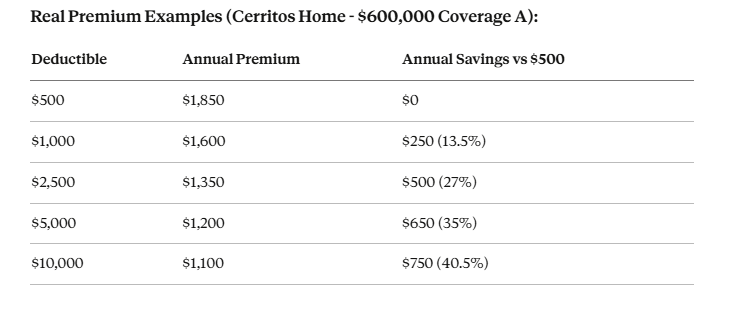
The relationship between deductible and premium is inverse:
Higher deductible = Lower premium
Lower deductible = Higher premium
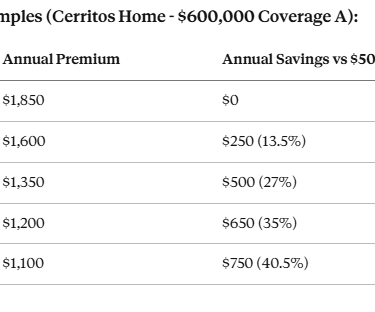
But the savings aren't linear. Moving from $500 to $1,000 deductible saves more (percentage-wise) than moving from $2,500 to $5,000.
Key Observations:
Biggest savings jump: $500 to $1,000 (saves $250/year)
Diminishing returns: $5,000 to $10,000 only saves $100/year more
Sweet spot for many: $2,500 deductible (good balance of savings and manageable out-of-pocket)
The Math Over Time:
Choosing $2,500 deductible instead of $500:
Annual savings: $500
10-year savings: $5,000
Difference in deductibles: $2,000
If you go 10 years without a major claim, you're ahead $5,000.
If you have one major claim in 10 years:
Extra out-of-pocket: $2,000 (higher deductible)
Premium savings: $5,000
Net benefit: $3,000 ahead
If you have two major claims in 10 years:
Extra out-of-pocket: $4,000
Premium savings: $5,000
Net benefit: $1,000 ahead
You'd need THREE major claims in 10 years to lose money with the higher deductible—and that's before considering the premium increases from filing multiple claims.
How to Choose the Right Deductible
Choosing your deductible isn't about premium savings alone. It's about balancing four factors:
Factor 1: Your Emergency Fund
Golden Rule: Never choose a deductible higher than your emergency fund.
If you have $3,000 in emergency savings, don't choose a $5,000 deductible. You won't be able to afford the out-of-pocket cost if you need to file a claim.
Recommended approach:
Emergency fund $1,000-$2,000: Choose $500-$1,000 deductible
Emergency fund $3,000-$5,000: Choose $1,000-$2,500 deductible
Emergency fund $5,000-$10,000: Choose $2,500-$5,000 deductible
Emergency fund $10,000+: Choose $5,000-$10,000 deductible
Factor 2: Your Risk Tolerance
Some people sleep better knowing they'd only owe $500 out-of-pocket for a claim. Others are comfortable with $5,000 risk in exchange for premium savings.
Questions to ask yourself:
How would I feel paying $1,000 vs $5,000 after a disaster?
Am I comfortable accepting more risk to save money?
Would a high deductible cause financial stress even if I could technically afford it?
Factor 3: Your Home's Condition and Risks
Choose LOWER deductible if:
Your home is older (more likely to have claims)
You live in high-risk area (wildfire zone, flood-prone, etc.)
Your home has known issues (old roof, old plumbing)
You've had claims in the past
You rent out the property (more risk exposure)
Choose HIGHER deductible if:
Your home is newer (less likely to have issues)
Well-maintained property
No known defects or aging systems
Claims-free history
Good neighborhood (low crime/fire risk)
Factor 4: Your Claiming Philosophy
Will you file small claims?
Some homeowners file claims for anything over their deductible. Others only file for truly catastrophic losses.
Consider:
Filing a claim often increases your premium for 3-5 years
Premium increase from one claim can exceed the claim payout
Multiple claims can lead to policy non-renewal
You may want to avoid small claims regardless of deductible
If you plan to only file for major losses (>$10,000), choose a higher deductible and pocket the premium savings.
The Sweet Spot: What Most Homeowners Should Choose
Based on three decades of helping California homeowners, here are my recommendations:
For Most Cerritos Homeowners:
$2,500 deductible
Why this works:
Manageable out-of-pocket for most families with modest savings
Significant premium savings (20-30% vs $500 deductible)
Discourages small claims that hurt you more than help
Affordable enough that you won't delay repairs after loss
Not so low that you're overpaying on premiums
For Well-Funded Homeowners:
$5,000-$10,000 deductible
Who this is for:
Strong emergency fund ($15,000+)
Stable income
Low risk tolerance for premium waste
Plan to only file major claims
Benefits:
Lowest premiums (30-40% savings)
Eliminates temptation to file small claims
Forces self-insurance for minor losses
Maximum long-term savings
For Budget-Conscious or High-Risk Homes:
$1,000 deductible
Who this is for:
Limited emergency savings
Older home with higher claim likelihood
Peace of mind important
Cannot afford large out-of-pocket expense
Benefits:
Lower out-of-pocket if claim occurs
More accessible
Still provides some premium savings vs $500
What to Avoid:
❌ $500 deductible: Rarely makes sense. Premium is high, savings are minimal, and you should avoid filing claims this small anyway.
❌ Deductible higher than emergency fund: You won't be able to afford the claim.
Strategies to Afford a Higher Deductible
Want the premium savings of a higher deductible but worried about affording the out-of-pocket cost? Use these strategies:
Strategy 1: Build Your "Deductible Fund"
Take your annual premium savings and deposit it into a dedicated savings account.
Example:
Switch from $500 to $2,500 deductible
Annual savings: $500
After 5 years: $2,500 in fund (covers entire deductible)
After 10 years: $5,000 in fund
Now you can afford the higher deductible using premium savings, and you keep the extra if you don't claim.
Strategy 2: Gradual Increase
Don't jump from $500 to $5,000 immediately. Increase gradually:
Year 1-2: $1,000 deductible, save premium difference Year 3-4: $2,500 deductible, continue saving Year 5+: $5,000 deductible with strong savings cushion
Strategy 3: Use Home Equity Line of Credit (HELOC)
If you have home equity but limited liquid savings:
Establish HELOC as backup for deductible
Choose higher deductible for premium savings
Only tap HELOC if claim occurs
Pay off quickly from savings/income
Strategy 4: Bundle and Redirect Savings
Bundle home and auto insurance (save 15-25%)
Increase home deductible (save 20-30% more)
Use combined savings to build emergency fund
Within 2-3 years, you'll have cushion for higher deductible
Strategy 5: Consider Payment Plan
Some contractors and restoration companies offer payment plans for deductible amounts. Check before filing claim.
When to Actually File a Claim
Just because damage exceeds your deductible doesn't mean you should file a claim.
File a Claim When: ✅ Damage significantly exceeds deductible (2-3x minimum) ✅ Loss is catastrophic (total loss, major damage) ✅ You cannot afford repairs out-of-pocket ✅ Liability is involved (someone injured on property) ✅ Required by insurance policy (must report certain losses)
Don't File a Claim When: ❌ Damage barely exceeds deductible ❌ You can afford repair ❌ Small loss ($2,000-$5,000) ❌ You've had recent claims already ❌ Near policy renewal (could affect renewal)
Why?
Claims affect premiums for 3-5 years:
One claim: 20-40% premium increase
Two claims: 40-80% premium increase
Three claims: Policy non-renewal likely
Real Example:
$3,000 theft claim with $2,500 deductible
Immediate:
Insurance pays: $500
You pay: $2,500
Next 5 years:
Premium before claim: $1,500/year
Premium after claim: $1,950/year (30% increase)
Extra cost over 5 years: $2,250
Total cost of filing this claim:
Deductible: $2,500
Premium increases: $2,250
Total: $4,750
Insurance payout: $500
You lost $4,250 by filing this claim.
Better decision: Pay the $3,000 out-of-pocket, avoid claim, keep low premiums.
The Rule: Only file claims worth at least 3-5 times your annual premium.
How Deductibles Work with Different Types of Claims
Total Loss Claims:
If your home is destroyed (total loss), your deductible still applies.
Example:
Home insured for $650,000
Total loss from fire
Deductible: $2,500
You receive: $647,500
You still owe the deductible even though you lost everything.
Partial Loss Claims:
Most claims are partial losses (roof damage, kitchen fire, theft, etc.)
Example:
Kitchen fire damage: $35,000
Deductible: $2,500
Insurance pays: $32,500
Liability Claims:
If someone is injured on your property and you're liable, your liability coverage (Coverage E) typically has NO deductible.
Example:
Guest slips and falls
Medical bills: $50,000
Lawsuit settlement: $100,000
Your deductible: $0
Insurance pays: $150,000 (up to your liability limit)
Additional Living Expenses (Coverage D):
If your home is uninhabitable due to covered loss, your ALE coverage typically uses the SAME deductible as your dwelling coverage.
Example:
Fire forces you out of home for 4 months
Hotel and food costs: $12,000
Deductible: $2,500
Insurance pays: $9,500
Other Structures (Coverage B):
Damage to detached garage, shed, fence uses your standard deductible.
Per Occurrence:
Deductibles apply per occurrence, not per item.
Example:
Hail damages roof, windows, and car
Roof: $15,000
Windows: $5,000
(Car covered by auto policy separately)
Total home damage: $20,000
Deductible: $2,500 (once, not per item)
Insurance pays: $17,500
California-Specific Deductible Considerations
Wildfire Risk:
If you live in high-fire-risk area:
Consider LOWER deductible (higher claim likelihood)
Ensure deductible is affordable if evacuated
Review whether fire has separate deductible (rare)
Earthquake Coverage:
California earthquake deductibles are 10-25% of Coverage A.
Recommendation:
If you can afford $75,000-$150,000 out-of-pocket: Get earthquake coverage
If you cannot: Save money in emergency fund instead
FAIR Plan:
If you're in FAIR Plan (high-risk state program):
Deductible options may be limited
Typically higher than standard market
Check what options are available
Brush Clearance Requirements:
Maintaining proper brush clearance around your home can:
Prevent claims (reduces risk)
Allow higher deductible choice
Potentially qualify for discounts
Common Deductible Mistakes
Mistake #1: Choosing Default Without Thinking
Many homeowners select whatever deductible the agent suggests or whatever was on the quote, without analyzing what makes sense for their situation.
Fix: Actively choose deductible based on your emergency fund and risk tolerance.
Mistake #2: Not Knowing What Deductible You Have
Ask a homeowner what their deductible is, and many can't answer.
Fix: Pull out your policy right now and check. Make note of:
Standard deductible amount
Whether it's dollar or percentage
Any special deductibles (wind, earthquake, etc.)
Mistake #3: Percentage Deductible Surprise
Homeowners with percentage deductibles often don't realize the dollar amount until they file a claim.
Fix: Calculate your percentage deductible:
Coverage A × Percentage = Your deductible
Example: $700,000 × 2% = $14,000
Mistake #4: Not Updating After Home Value Increases
If your Coverage A increases (home value rises, you renovate), your percentage deductible increases too.
Fix: Review deductible dollar amount annually if you have percentage deductible.
Mistake #5: Filing Small Claims
Filing claims barely above your deductible costs you more in premium increases than you receive in payout.
Fix: Only file claims worth 3-5x your annual premium.
Mistake #6: Different Deductibles for Home and Auto
Some people have $500 deductible on home but $2,500 on auto (or vice versa) without logical reason.
Fix: Apply same decision-making framework to all insurance deductibles.
What to Do Next
Action Plan:
This Week:
Find your current homeowners insurance policy
Check your deductible (declarations page)
Verify whether it's dollar amount or percentage
Check for special deductibles (wind, earthquake)
Calculate percentage deductibles to know dollar amount
This Month:
Review your emergency fund
Decide if current deductible is appropriate
Get quotes for different deductible amounts
Calculate premium savings
Make change if beneficial
Annually:
Review deductible during policy renewal
Adjust if financial situation changes
Verify Coverage A hasn't increased significantly (affecting percentage deductibles)
Get Your Personalized Deductible Recommendation
Choosing the right homeowners insurance deductible requires balancing premium savings with financial security. There's no one-size-fits-all answer—the right deductible depends on your emergency fund, risk tolerance, home condition, and financial goals.
Contact Pinoy General Insurance Services for:
Free policy review
Deductible analysis and recommendations
Premium quotes at multiple deductible levels
Guidance on building emergency fund
Strategies to optimize total insurance costs
Located at 17304 Norwalk Blvd, Cerritos, CA 90703, we've been helping Orange County homeowners optimize their insurance since 1993. As a founding member of the Artesia Chamber of Commerce, we're committed to helping local residents make smart insurance decisions.
Call (562) 402-1737 or email info@pinoygeneralinsurance.com for your free policy review.
Your deductible is one of the most important decisions in your homeowners insurance. Make sure it's right for you.
About the Author:
Felix Lopez is a licensed insurance agent and business development manager at Pinoy General Insurance Services in Cerritos, California. Since 1993, Pinoy General Insurance has been helping Orange County homeowners understand and optimize their insurance coverage, including choosing appropriate deductibles that balance cost savings with financial security. Felix specializes in helping clients make informed decisions about deductibles based on their unique financial situations and risk profiles.
Pinoy General Insurance Services
17304 Norwalk Blvd
Cerritos, CA 90703
Phone: (562) 402-1737
Email: info@pinoygeneralinsurance.com
Website: pinoygeneralinsurance.com
Founding Member - Artesia Chamber of Commerce
Serving Orange County Since 1993
Contact Us Today
Contact us here at Pinoy General Insurance Services today for all your insurance needs.
Phone
© 2025 Pinoy General Insurance Services. All rights reserved.