
The Complete Guide to Insuring Teen Drivers in California (2026)
Everything California parents need to know about adding teen drivers to car insurance, from costs to discounts to safety strategies.
AUTO INSURANCE
Felix | Pinoy General Insurance Services
3/6/202612 min read


Adding a teenager to your car insurance policy is one of the most expensive parenting milestones you'll face. California parents can expect their auto insurance premiums to increase by 50-100% when they add a teen driver—sometimes even more depending on the vehicle and coverage levels.
But here's the reality: most parents approach teen driver insurance completely wrong. They focus solely on finding the cheapest rate without understanding the coverage gaps, discount opportunities, or safety strategies that could save them thousands while actually protecting their teen better.
After helping hundreds of Cerritos families navigate teen driver insurance since 1993, I've seen the same mistakes repeated over and over. More importantly, I've seen the families who do it right—the ones who save 30-40% through strategic planning while ensuring their teens have proper protection.
This guide covers everything you need to know about insuring teen drivers in California, based on real data, actual premiums, and three decades of experience helping local families.
Why Teen Driver Insurance Costs So Much
Let's start with the uncomfortable truth: teen drivers are genuinely high-risk.
The Statistics Are Sobering:
Drivers aged 16-19 are nearly 3 times more likely to be in a fatal crash than drivers 20 and older (NHTSA data)
Teen drivers have the highest crash rate of any age group in California
25% of teen drivers are involved in an accident within their first year of driving
Motor vehicle crashes are the leading cause of death for U.S. teens
Insurance companies aren't arbitrarily charging you more—they're responding to mathematical risk. Every dollar your premium increases reflects actual claims data showing that teen drivers cost insurers significantly more in payouts.
What Drives Teen Insurance Costs:
Inexperience: Teens simply haven't developed the reflexes, judgment, and hazard recognition that comes with years of driving
Risk-Taking Behavior: Studies show teens are more likely to speed, text while driving, and make impulsive decisions
Brain Development: The prefrontal cortex (responsible for decision-making) isn't fully developed until age 25
Peer Pressure: Teens with other teen passengers have 3x higher crash risk
Night Driving: Fatal crash rates for teen drivers are 3x higher at night
Understanding why insurance is expensive helps you make smarter decisions about coverage, vehicles, and risk management.
How Much Will It Actually Cost?
Here's what real California families are paying to add teen drivers in 2026 (based on our actual client data in Orange County):
Average Premium Increase by Driver Age:
16-year-old driver: $2,400-$3,600/year increase ($200-$300/month)
17-year-old driver: $2,200-$3,400/year increase ($183-$283/month)
18-year-old driver: $2,000-$3,200/year increase ($167-$267/month)
19-year-old driver: $1,800-$2,800/year increase ($150-$233/month)
Factors That Affect Your Specific Cost:
Your actual premium depends on several variables:
The Vehicle They Drive:
Older sedan (Honda Civic, Toyota Corolla): Lower end of range
Newer SUV or sports car: Upper end of range or higher
Vehicle safety features can reduce costs 5-10%
Your Current Insurance Company:
Some insurers specialize in teen drivers and offer better rates
Others penalize teen drivers more heavily
Rate differences can exceed $1,000/year between carriers for identical coverage
Your Location in California:
Urban areas (Los Angeles, San Francisco): Higher rates due to accident density
Suburban areas (Cerritos, Orange County): Moderate rates
Rural areas: Generally lower rates
Your Teen's Gender:
Male teens typically cost 10-20% more than female teens
This gap narrows significantly by age 20-21
Some states have banned gender-based pricing, but California still allows it
Coverage Levels:
Minimum liability (15/30/5): Cheapest but risky
Standard coverage (100/300/100): Moderate cost
Full coverage with low deductibles: Most expensive but best protection
Real Example from a Cerritos Family:
The Martinez Family - 2025 Client
Parents: 2 drivers, clean records, 2019 Honda CR-V and 2021 Toyota Camry
Original premium: $2,400/year ($200/month)
Added 16-year-old son driving the Camry
New premium with teen: $4,900/year ($408/month)
Increase: $2,500/year or $208/month
After shopping 15 carriers and applying all available discounts, we reduced their premium to $3,800/year—a savings of $1,100 annually compared to just adding the teen to their existing policy.
Should You Add Them to Your Policy or Buy Separate Insurance?
This is one of the most common questions we get, and the answer is almost always the same: keep them on your policy.
Why Keeping Teens on Your Policy Usually Saves Money:
Multi-Car Discount: Adding a teen driver usually maintains or increases your multi-car discount
Multi-Policy Discount: Your homeowners/renters insurance bundle discount stays intact
Shared Liability Protection: Your policy's liability limits protect the entire household
Easier Claims Management: One policy means one deductible, one claims process
Administrative Simplicity: One renewal date, one payment, one company to deal with
The Math:
Adding teen to parent's policy: $2,500/year increase (typical)
Separate policy for teen: $4,500-$7,000/year (typical)
Savings by staying on parent's policy: $2,000-$4,500/year
The Only Time a Separate Policy Makes Sense:
Emancipated Minor: Teen lives independently and owns their vehicle
Teen Owns Expensive Vehicle: In rare cases, separating a high-value car can reduce overall costs
Parents Don't Own Vehicles: If parents don't drive and only the teen needs coverage
Excluded Driver Situation: Complex family situations requiring separation of risk
For 99% of California families, keeping teens on the family policy is significantly cheaper.
The Best Way to Add a Teen Driver to Your Policy
Here's the strategic approach that saves our clients the most money:
Step 1: Shop BEFORE Adding Them (3-6 Months Before Their License)
This is the single most important step most parents skip. Here's why it matters:
Once you add a teen to your current policy, switching insurers becomes harder (you're locked in for the policy term)
Different companies treat teen drivers dramatically differently—rate variations of 40-60% are common
Some companies offer "new driver" discounts that expire after the first policy term
You want to start fresh with the best company for teen drivers, not be stuck with whoever you happened to use before
What to Do:
Get quotes from 10-15 insurance companies 6 months before your teen gets their license
Compare identical coverage levels (don't just look at the cheapest option)
Ask specifically about teen driver discounts and programs
Lock in the best rate before adding the teen
Step 2: Choose the Right Vehicle
The car your teen drives has a massive impact on insurance costs. Here's what actually matters:
Best Vehicles for Teen Drivers (Lowest Insurance Costs):
Mid-size sedans 3-7 years old (Honda Accord, Toyota Camry, Mazda 6)
Older compact cars with good safety ratings (Honda Civic, Toyota Corolla)
Mid-size SUVs with strong safety features (Honda CR-V, Toyota RAV4)
Worst Vehicles for Teen Drivers (Highest Insurance Costs):
Sports cars (Mustang, Camaro, anything with a V8)
Brand new vehicles (depreciation risk + high repair costs)
Luxury vehicles (expensive parts, repair costs)
Trucks with high horsepower
Two-door coupes (statistically higher teen accident rates)
The Safety Feature Discount:
Modern vehicles with these features can reduce teen driver premiums by 5-15%:
Forward collision warning
Automatic emergency braking
Lane departure warning
Blind spot monitoring
Electronic stability control
Anti-lock brakes
Real Example:
2016 Honda Civic LX (Safety Features) vs 2015 Ford Mustang V6
Same 17-year-old driver, same coverage
Civic: $3,200/year additional premium
Mustang: $4,800/year additional premium
Difference: $1,600/year just based on vehicle choice
Step 3: Maximize Every Available Discount
Teen driver discounts can reduce your premium by 20-40% if you stack them correctly. Here's what's actually available in California:
Good Student Discount (10-25% savings):
Requires 3.0+ GPA or B average
Must provide report card or transcript
Renewal typically required every 6 months
Applies until age 25 at most companies
Average savings: $400-$800/year
Driver Training Discount (5-15% savings):
Completion of approved driver's education course
Must be state-certified program
Discount typically lasts 3 years
Some companies require both classroom and behind-the-wheel training
Average savings: $200-$500/year
Away at School Discount (10-30% savings):
Student attends college 100+ miles from home
Vehicle remains at home (student doesn't take car to school)
Requires proof of enrollment
Usually requires student to be listed as occasional driver
Average savings: $300-$900/year
This is the biggest discount most parents don't know about. If your teen goes to college without a car, you can reduce their insurance cost by up to 30%.
Defensive Driving Discount (5-10% savings):
Completion of approved defensive driving course
Some companies offer teen-specific programs
May be stackable with driver training discount
Average savings: $150-$350/year
Telematics/Usage-Based Discount (5-30% savings):
Mobile app or device monitors driving behavior
Tracks speed, braking, acceleration, time of day
Good driving habits = increasing discounts over time
Programs: Snapshot (Progressive), Drivewise (Allstate), SmartRide (Nationwide)
Potential savings: $200-$1,000/year
This is controversial among parents: Some see it as invasive surveillance. Others view it as valuable accountability. The financial incentive is real—safe teen drivers can earn substantial discounts.
Stacking Example (Real Client from Norwalk):
Base teen driver cost: $3,200/year
Good student discount (20%): -$640
Driver training discount (10%): -$320
Telematics discount (15%): -$480
Total discounts: $1,440/year
Final cost: $1,760/year (45% savings)
Step 4: Set Clear Coverage Expectations
This is where most parents make expensive mistakes. Let me be direct: do not carry minimum liability coverage with a teen driver.
California Minimum Coverage (15/30/5):
$15,000 per person for bodily injury
$30,000 per accident for bodily injury
$5,000 for property damage
Why This Is Dangerously Low for Teen Drivers:
A teen driver rear-ends another vehicle at a red light. The other driver suffers neck injuries requiring surgery. Medical bills: $85,000. Physical therapy: $15,000. Lost wages: $20,000. Total: $120,000.
Your policy limit: $15,000 per person.
You're personally liable for $105,000.
With teen drivers, the risk of a serious accident causing significant damages is simply too high to carry minimum coverage. One accident can financially devastate your family.
Recommended Coverage for Teen Drivers:
Liability:
Minimum: 100/300/100
Better: 250/500/100
Best: 500/500/100 (surprisingly affordable at these levels)
Additional Protection:
Uninsured/Underinsured Motorist: Match your liability limits
Medical Payments: $5,000-$10,000
Collision: Consider $1,000 deductible on older vehicles
Comprehensive: $500-$1,000 deductible
The Cost Difference Isn't What You Think:
Moving from California minimum (15/30/5) to proper coverage (100/300/100) typically costs only $15-$40/month more—a fraction of the financial risk you're eliminating.
Step 5: Consider a Parent-Teen Driving Contract
The insurance policy protects you financially. A driving contract protects your teen physically.
Key Elements to Include:
Zero Tolerance Rules:
No phone use while driving (even at red lights)
No passengers for first 6-12 months
No driving between 11pm-5am (California law: midnight-5am restriction for first year)
No alcohol/drugs (obviously, but state it explicitly)
Earned Privileges:
Start with daytime, local driving only
Gradually add highway driving, night driving, passengers
Tie expanded privileges to demonstrated safe driving
Consequence System:
First violation: Loss of driving privileges for 1-2 weeks
Second violation: Loss of driving privileges for 1 month
Third violation: Loss of driving privileges for 3-6 months
Ticket/accident: Teen pays insurance increase and deductible
Financial Responsibility:
Teen contributes to gas, insurance, or both
Teen pays for tickets and increases in premium
Teen maintains good grades for discount eligibility
Why This Matters:
Studies show teens with parent-set driving contracts have 30% fewer crashes and 50% fewer traffic violations. The conversation itself—sitting down and going through expectations—creates accountability that reduces risky behavior.
Common Teen Driver Insurance Mistakes to Avoid
After three decades in this business, I've seen these mistakes cost families tens of thousands of dollars:
Mistake #1: Not Listing the Teen Driver
Some parents think they can save money by not formally adding their teen to the policy. This is insurance fraud and can result in:
Denied claims
Policy cancellation
Difficulty getting coverage in the future
Personal liability for all damages
Potential criminal charges
Every insurance company will discover an unlisted teen driver eventually—usually after an accident when it's too late.
Mistake #2: Making Assumptions About "Occasional Driver" Status
"Occasional driver" means your teen drives less than 50% of the time and doesn't have regular access to a vehicle. If your teen:
Has their own car (even if it's titled to you)
Drives to school daily
Has regular use of any household vehicle
They're not an occasional driver—they're a primary or regular driver and must be listed as such.
Mistake #3: Buying a Car in the Teen's Name
Never, ever put a vehicle title in your teen's name. Here's why:
Insurance costs 2-3x more for teen-owned vehicles
Teen becomes personally liable in lawsuits
Harder to maintain family policy discounts
Limited insurance options (many companies won't write policies for teen-owned vehicles)
Keep all vehicles titled to parents until the teen is 21-25 and has established their own insurance history.
Mistake #4: Failing to Re-Shop After the First Year
Teen driver rates vary wildly between companies, and what's cheapest when you add them might not be cheapest a year later. Some companies:
Offer introductory discounts that expire
Increase rates more aggressively after first-year claims
Don't reward good driving as quickly as competitors
Best Practice: Re-shop your teen driver insurance every year for the first 3-4 years. Rate variations of $800-$1,500/year are common between companies for the exact same coverage.
Mistake #5: Prioritizing Price Over Coverage
Yes, teen driver insurance is expensive. But the cheapest policy is rarely the best value. Consider:
Claims service: Will they fight for you or against you?
Financial strength: Will they be around in 5 years?
Coverage limits: Are you actually protected or just insured?
Deductibles: Can you afford the out-of-pocket costs?
A policy that costs $300/year less but fights every claim and provides terrible service isn't saving you money.
Special Situations: What to Do If...
Your Teen Gets a Ticket
First ticket or minor violation:
Premium increase: 15-30% typically
Duration: Usually 3 years
Cost: $400-$800/year additional
Action: Consider traffic school to remove the point (if eligible)
Multiple tickets or serious violations:
Premium increase: 40-80% or more
Risk: Some companies will non-renew your policy
Action: Expect to shop for new coverage, possibly with a high-risk insurer
Your Teen Has an Accident
At-fault accident:
Premium increase: 20-50% depending on damage amount
Duration: 3-5 years typically
Surcharge: Usually kicks in at renewal, not immediately
Action: File a claim for damage above your deductible + 20-30%
Not-at-fault accident:
Most companies won't surcharge
Some companies still increase rates 5-10%
Your claim history still shows the accident
Your Teen Goes to College
Without a car:
Apply for "away at school" discount immediately
Keep them listed as occasional driver
Maintain good student discount with transcripts
Potential savings: 20-30% of their portion of premium
With a car:
Update address to college location (affects rates)
Consider storage insurance if car sits unused
Verify coverage extends to out-of-state (most do)
May need separate policy if more than 6 months away
Your Teen Joins the Military
Active duty service members:
May qualify for military discounts (USAA, Armed Forces Insurance)
Vehicle in storage: Comprehensive-only coverage option
Deployment: Suspension of coverage possible with some insurers
Benefits: Better rates through military-specific companies
When Teen Drivers Become Adults: The Path to Lower Rates
The good news: teen driver rates don't last forever. Here's when costs typically decrease:
Age-Based Rate Reductions:
Age 18: 5-10% decrease
Age 19: 10-15% decrease
Age 21: 15-25% decrease (often when rates drop significantly)
Age 25: 20-35% decrease (full "adult" rates kick in)
Milestone-Based Improvements:
3 years claim-free: 10-20% decrease
5 years licensed: 15-25% decrease
Marriage: 5-15% decrease (yes, married drivers get better rates)
Homeownership: 5-10% decrease
By age 25 with a clean record, your child's insurance costs should be 50-70% lower than they were at age 16.
The Bottom Line: What This Costs You in Real Dollars
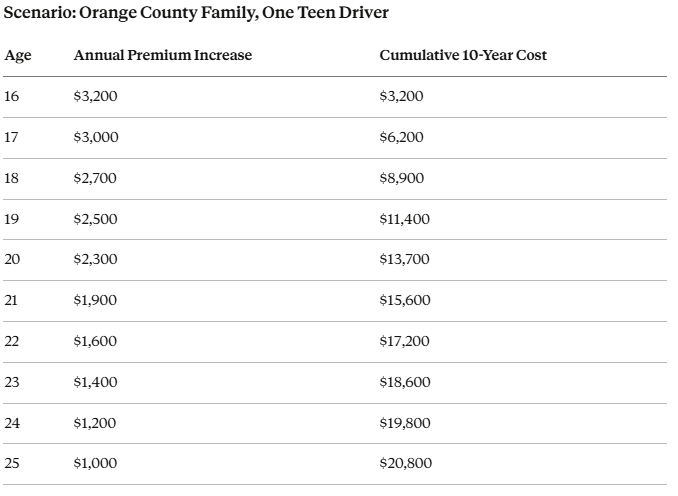
Let's do the full math for a California family adding a 16-year-old driver and keeping them insured through age 25:
Total cost to insure a teen driver from age 16-25: approximately $20,800
This assumes clean driving record and good student discounts applied. With accidents or tickets, add $5,000-$15,000 to this total.
But here's the critical perspective: That $20,800 over 10 years is the cost of protection. Without insurance:
One serious accident could bankrupt your family
Medical bills alone from injuring another person can exceed $200,000
You'd be personally liable for all damages
Your assets (home, savings, retirement) would be at risk
Teen driver insurance is expensive because teen driving is risky. The insurance doesn't create the risk—it protects you from it.
How Pinoy General Insurance Services Helps Cerritos Families
Since 1993, we've been helping local families navigate the teen driver insurance challenge. Here's our process:
1. Pre-License Consultation (Free)
We meet with families 3-6 months before their teen gets licensed to:
Review your current insurance situation
Explain coverage options and costs
Create a strategic plan for adding the teen driver
Identify every available discount
2. Comprehensive Quote Shopping
We shop your coverage with 15+ insurance companies including:
Major carriers (State Farm, Allstate, Farmers, Nationwide)
Regional specialists (Mercury, CSAA, Wawanesa)
High-value carriers (Chubb, Pure, AIG)
Specialized programs for teen drivers
This isn't about getting you the cheapest policy—it's about finding the best value: the right coverage at the best price with companies that actually pay claims.
3. Discount Maximization
We help you qualify for every available discount:
Good student discount setup and renewal reminders
Driver training course recommendations
Telematics program enrollment and monitoring
Away-at-school verification
Vehicle selection guidance to minimize costs
4. Annual Review & Re-Shopping
Teen driver rates change dramatically year over year. We:
Review your coverage annually
Re-shop with all carriers
Adjust coverage as vehicles and situations change
Track your teen's driving record and address issues immediately
5. Claims Advocacy
If your teen has an accident, we:
Guide you through the claims process
Advocate with the insurance company on your behalf
Manage rate impact and help find alternative coverage if needed
Provide guidance on tickets, accidents, and violations
What to Do Next
If you have a teen driver or will soon, here's your action plan:
Immediate (Today):
Review your current auto insurance policy and coverage limits
Check if your teen qualifies for good student discount (need 3.0+ GPA)
Discuss the teen driving contract concept with your spouse/co-parent
3-6 Months Before License:
Schedule a pre-license consultation with our office
Get comprehensive quotes from 10-15 insurance companies
Identify the best vehicle options for your teen to drive
Enroll teen in driver education course (for discount eligibility)
At License Time:
Add teen to your policy with the best company identified
Implement the parent-teen driving contract
Set up telematics monitoring if available
Provide report cards for good student discount verification
Annually Thereafter:
Re-shop coverage every year for first 3-4 years
Update good student discount with new transcripts
Adjust coverage based on vehicle age and value
Review driving record and address any violations
Get Your Free Teen Driver Insurance Quote
Adding a teen driver to your insurance doesn't have to be overwhelming or overpriced. With proper planning, strategic vehicle selection, and comprehensive discount application, most Cerritos families save $800-$1,500 per year compared to just adding the teen to their existing policy without shopping.
Contact Pinoy General Insurance Services today for:
Free teen driver insurance consultation
Quotes from 15+ insurance companies
Comprehensive discount analysis
Parent-teen driving contract template
Vehicle selection guidance
We're located at 17304 Norwalk Blvd, Cerritos, CA 90703, and we've been helping Orange County families since 1993.
As a founding member of the Artesia Chamber of Commerce, we're deeply connected to our community and committed to protecting local families.
Call us at (562) 402-1737 or email info@pinoygeneralinsurance.com to schedule your free consultation.
Teen driver insurance is one of the most important—and expensive—insurance decisions you'll make. Don't navigate it alone.
About the Author:
Felix Lopez is a licensed insurance agent and business development manager at Pinoy General Insurance Services in Cerritos, California. Since 1993, Pinoy General Insurance has been helping Orange County families protect their assets and loved ones through comprehensive insurance solutions. Felix specializes in helping families navigate the teen driver insurance process, with a focus on maximizing discounts and ensuring proper protection.
Contact Us Today
Contact us here at Pinoy General Insurance Services today for all your insurance needs.
Phone
© 2025 Pinoy General Insurance Services. All rights reserved.