
Understanding Actual Cash Value vs. Replacement Cost Coverage
Critical differences between ACV and replacement cost coverage, how each affects your claim payouts, and which is right for your situation.
INSURANCE TIPSHOME INSURANCE
Felix | Pinoy General Insurance Services
3/23/202611 min read


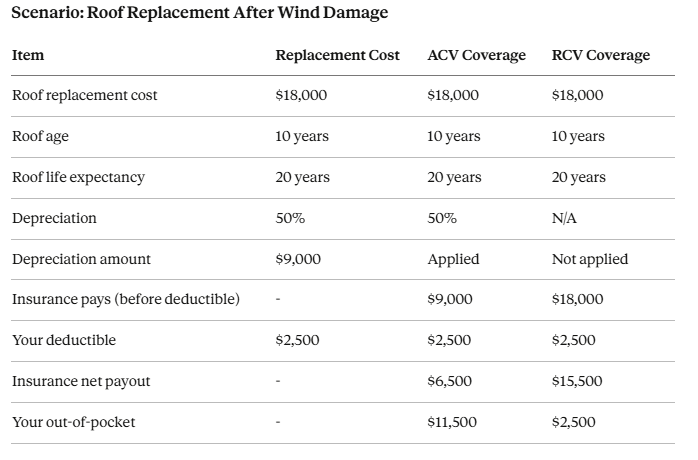
You file a claim after a fire damages your home. The insurance adjuster determines your 10-year-old roof needs complete replacement. Cost: $18,000.
You're expecting an $18,000 check (minus your deductible). Instead, you receive $9,000.
Confused and frustrated, you call your insurance company. They explain: "Your policy provides Actual Cash Value coverage for your roof, not Replacement Cost. We've paid you the depreciated value."
You now owe $9,000 out-of-pocket to replace your roof—money you don't have.
This scenario happens to California homeowners every single day. Most don't understand the difference between Actual Cash Value (ACV) and Replacement Cost Value (RCV) coverage until it's too late—until they're holding a claim check that's 40-60% less than they expected.
After helping thousands of Orange County homeowners navigate insurance claims since 1993, I can tell you that understanding ACV vs. RCV is one of the most important—and most misunderstood—aspects of homeowners insurance.
This guide explains exactly what each type of coverage means, how they affect your claim payouts, what they cost, and which one you should have.
What Is Actual Cash Value (ACV)?
Simple Definition: The depreciated value of your property at the time of loss.
Formula: Replacement Cost - Depreciation = Actual Cash Value
How It Works:
Your 10-year-old roof is damaged beyond repair.
Cost to replace with new roof: $18,000 (Replacement Cost)
Depreciation (10 years at 5% per year): $9,000 (50% depreciated)
Actual Cash Value: $9,000
Insurance pays: $9,000 (minus your deductible) You pay out-of-pocket: $9,000 to fully replace the roof
The Concept:
ACV coverage assumes your damaged property had "used" value, not new value. You're compensated for what the item was worth immediately before the loss—accounting for age, wear and tear, and condition.
Think of it like selling a used car:
You bought a car for $30,000 ten years ago
Today it's worth $8,000 (depreciated)
If it's totaled, you get $8,000, not $30,000
ACV insurance works the same way
How Depreciation Is Calculated:
Insurance companies use depreciation schedules based on:
1. Expected Useful Life
Roof: 15-25 years (depending on material)
HVAC: 15-20 years
Water heater: 8-12 years
Appliances: 10-15 years
Carpet: 5-10 years
Paint: 3-7 years
2. Age of Item
5-year-old roof with 20-year life expectancy = 25% depreciated
10-year-old HVAC with 20-year life = 50% depreciated
8-year-old water heater with 10-year life = 80% depreciated
3. Condition
Well-maintained items depreciate slower
Neglected items depreciate faster
Damage accelerates depreciation
Real ACV Claim Example:
Cerritos Home - Kitchen Fire Damage
Items Damaged:
Kitchen cabinets (8 years old)
Countertops (8 years old)
Flooring (8 years old)
Appliances (5-7 years old)
Paint (6 years old)
Replacement Costs:
Cabinets: $12,000
Countertops: $4,000
Flooring: $3,500
Appliances: $6,000
Paint/prep: $2,500 Total Replacement Cost: $28,000
ACV Calculation (40-60% depreciation):
Cabinets: $12,000 - 50% = $6,000
Countertops: $4,000 - 50% = $2,000
Flooring: $3,500 - 60% = $1,400
Appliances: $6,000 - 40% = $3,600
Paint: $2,500 - 50% = $1,250 Total ACV Payout: $14,250
With $1,000 deductible:
Insurance pays: $13,250
Homeowner needs to replace everything: $28,000
Out-of-pocket cost: $14,750
The homeowner expected insurance to cover most of the damage. Instead, they're covering more than half themselves.
What Is Replacement Cost Value (RCV)?
Simple Definition: The cost to replace or repair your property with new items of similar kind and quality, with NO deduction for depreciation.
Formula: Replacement Cost = Actual Cash Value + Depreciation
How It Works:
Your 10-year-old roof is damaged beyond repair.
Cost to replace with new roof: $18,000
Depreciation: Does NOT apply with RCV
Insurance pays: $18,000 (minus your deductible)
With $2,500 deductible:
Insurance pays: $15,500
You pay: $2,500 (only your deductible)
The Concept:
RCV coverage returns you to your pre-loss condition by paying the full cost to replace damaged items with new ones. You're not penalized for the age of your property.
Important: RCV Usually Involves Two Payments
Payment #1 - Actual Cash Value (Immediate): When you file the claim, insurance pays ACV immediately (replacement cost minus depreciation).
Payment #2 - Depreciation "Holdback" (After Repairs): After you actually replace or repair the damaged items, insurance pays the depreciation amount they withheld.
Why this two-step process? Insurance companies want proof you actually replaced the items before paying full replacement cost. This prevents people from pocketing depreciation money without making repairs.
Real RCV Claim Example:
Same Cerritos kitchen fire from above, but with RCV coverage
Immediate Payment (ACV): Insurance pays: $14,250 - $1,000 deductible = $13,250
Homeowner Replaces Everything: Total spent: $28,000
Depreciation Holdback Payment: Insurance pays additional: $13,750 (the depreciation amount)
Final Accounting:
Total insurance payout: $27,000 ($13,250 ACV + $13,750 depreciation)
Total repair cost: $28,000
Homeowner out-of-pocket: $1,000 (just the deductible)
This is how insurance should work—you pay your deductible, insurance pays the rest.
Side-by-Side Comparison: ACV vs. RCV
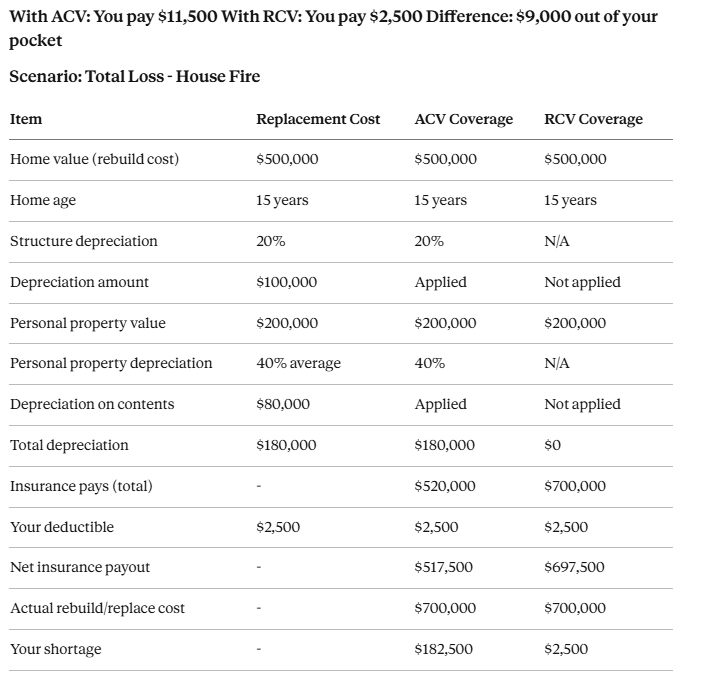
Let's look at identical claims under each coverage type:
With ACV: You're $182,500 short With RCV: You're covered (minus deductible)
This is why ACV coverage is dangerous for total losses.
When Each Type of Coverage Makes Sense
Replacement Cost Value (RCV) Is Right For:
✅ Primary residence (almost always)
Largest asset most people own
Cannot afford significant out-of-pocket costs for repairs
Want full protection and complete recovery after loss
Standard for most homeowners insurance
✅ Newer homes
Even with less depreciation, RCV provides better protection
Ensures you can fully repair/replace without financial strain
✅ Valuable personal property
Electronics, furniture, appliances add up quickly
Depreciation on contents can be 40-60%
RCV coverage essential for full recovery
✅ Homes with replacement cost over $300,000
Any significant loss creates large depreciation amounts
Cannot risk being undercompensated
✅ Homeowners with limited savings
Cannot afford to cover depreciation gap out-of-pocket
RCV provides predictable, affordable recovery
Actual Cash Value (ACV) Might Make Sense For:
⚠️ Rental/investment properties (sometimes)
Lower premium may align with investment strategy
Owner has capital reserves to cover gaps
Property generates income to fund shortfalls
BUT: Even here, RCV often better choice
⚠️ Vacation homes (rarely)
If owner has significant reserves
If willing to accept lower claim payouts
CAUTION: Most lenders require RCV coverage
⚠️ Very specific roof-only situations
Old roof near end of life (replacing soon anyway)
Willing to accept ACV for lower premium on roof only
NOTE: This should be specific roof endorsement, not whole policy
Who Should NEVER Have ACV Coverage:
❌ Primary residence homeowners ❌ Anyone with a mortgage (lenders typically require RCV) ❌ Homeowners with limited emergency savings ❌ Homes in high-risk areas (fire, wind, hail) ❌ Older homes (more depreciation = larger gaps)
The Bottom Line:
For 95%+ of California homeowners, Replacement Cost coverage is essential. The premium difference is small compared to the massive financial protection difference.
How Much More Does RCV Cost?
The Surprising Answer: Not Much
Typical Premium Difference:
ACV coverage premium: $1,200/year
RCV coverage premium: $1,400-1,500/year
Additional cost: $200-300/year ($17-25/month)
The ROI Analysis:
Scenario 1: No Claims in 20 Years
Extra premium paid for RCV: $4,500 over 20 years
Financial loss: $4,500
BUT: You had peace of mind and protection for 20 years
Scenario 2: One Major Claim in 20 Years
Extra premium paid for RCV: $4,500
Savings from RCV vs ACV on claim: $40,000-$100,000
Net benefit: $35,500-$95,500
Scenario 3: Total Loss
Extra premium paid: $4,500 (assume 20 years)
Savings from RCV vs ACV: $150,000-$200,000
Net benefit: $145,500-$195,500
You're "betting" $225/year that you might need full replacement coverage. The potential payout is 200-800 times your annual bet. This is excellent insurance value.
Special Situations: Roof Coverage
Many California homeowners have RCV coverage on their dwelling but ACV coverage on their roof due to age or insurer requirements.
How Roof-Only ACV Works:
Your policy states: "Replacement Cost coverage except roof is ACV if over 15 years old."
15-year-old roof damaged by wind:
Replacement cost: $18,000
Roof depreciation: 75% (15 years of 20-year life)
ACV payout: $4,500
Your deductible: $2,500
Net insurance payout: $2,000
You owe out-of-pocket: $16,000
This is why roof age matters when shopping for insurance.
Insurer Roof Age Requirements:
Many California insurers now have roof age restrictions:
Common Requirements:
Roof under 15 years: Full RCV coverage
Roof 15-20 years: ACV coverage only
Roof over 20 years: Coverage may be declined or excluded
What This Means:
If you're buying/refinancing a home with an old roof:
You may be required to replace roof before coverage
Or accept ACV coverage (and risk large out-of-pocket costs)
Or pay significantly higher premiums
Strategy:
If your roof is approaching 15 years:
Get inspection to document condition
Replace proactively before age restriction kicks in
Maintain detailed maintenance records
Some insurers offer RCV if roof is well-maintained despite age
Extended Replacement Cost and Guaranteed Replacement Cost
Beyond standard RCV, there are two enhanced options:
Extended Replacement Cost (ERC)
What it is: Coverage that pays ABOVE your dwelling limit (Coverage A) by a specific percentage.
Common options:
125% of Coverage A
150% of Coverage A
Example:
Coverage A (dwelling): $500,000
Extended Replacement Cost: 125%
Maximum payout: $625,000
When you need it: After major disasters, rebuilding costs surge due to:
Labor shortages (contractors in high demand)
Material shortages (lumber, roofing, fixtures)
Building code upgrades (new codes since home was built)
Real Scenario:
California wildfire destroys neighborhood
Your Coverage A: $500,000
Actual rebuild cost (surge pricing + code upgrades): $575,000
Without ERC:
Insurance pays: $500,000
You owe: $75,000
With 125% ERC:
Insurance pays: $575,000 (within 125% limit)
You owe: $0 (beyond deductible)
Cost: Typically adds 5-15% to premium ($75-200/year for most homes)
Guaranteed Replacement Cost (GRC)
What it is: Coverage that pays UNLIMITED amount to rebuild your home to pre-loss condition, regardless of Coverage A amount.
No caps, no limits—full replacement guaranteed.
Example:
Coverage A: $500,000
Actual rebuild cost after disaster: $750,000
GRC coverage pays: $750,000 (full amount)
Requirements:
Home must be insured to 100% of estimated replacement cost
Annual inflation adjustments required
Home must meet underwriting standards
Usually only available for homes under 20-30 years old
Cost: Typically adds 10-25% to premium ($150-350/year for most homes)
Availability:
GRC has become rare in California due to wildfire risks. Many insurers have:
Eliminated GRC options
Limited to specific areas
Restricted to newer homes only
If available, GRC is the gold standard of coverage—but increasingly hard to find.
How to Verify What Coverage You Have
Step 1: Find Your Declarations Page
This is the summary page of your policy showing:
Coverage amounts
Coverage types
Deductibles
Premium
Step 2: Look for Coverage A (Dwelling Coverage)
Find the section describing your dwelling coverage. Look for language like:
Replacement Cost Coverage:
"We will pay the cost to repair or replace with material of like kind and quality"
"Settlement based on replacement cost"
"No deduction for depreciation"
Actual Cash Value Coverage:
"We will pay the actual cash value of the damaged property"
"Settlement based on actual cash value"
"Replacement cost less depreciation"
Step 3: Check Coverage C (Personal Property)
Your dwelling might have RCV while your personal property has ACV. Check both.
Look for:
"Personal Property at Replacement Cost" = RCV
"Personal Property at Actual Cash Value" = ACV
Step 4: Check for Special Limitations
Look for endorsements or special provisions like:
"Roof coverage limited to ACV if over X years old"
"Certain items covered at ACV: [list]"
"Extended Replacement Cost: X%"
Step 5: When in Doubt, Call Your Agent
Ask specifically:
"Do I have Replacement Cost or Actual Cash Value coverage on my dwelling?"
"Do I have Replacement Cost or Actual Cash Value coverage on my personal property?"
"Are there any items covered at ACV instead of RCV?"
"Do I have Extended or Guaranteed Replacement Cost?"
Get written confirmation of your coverage type.
How to Switch from ACV to RCV
If you discover you have ACV coverage, switching to RCV is usually straightforward:
Step 1: Contact Your Insurance Company or Agent
Request to change from ACV to RCV coverage.
Step 2: Provide Any Required Information
Some insurers may require:
Home inspection (for older homes)
Roof inspection (if roof is older)
Updated photos
Verification of home value/replacement cost
Step 3: Review Premium Increase
Agent will quote new premium with RCV coverage.
Typical increase: $200-400/year for most homes
Step 4: Accept and Implement
Once you accept, change usually effective immediately or at next renewal.
Important: Don't cancel ACV coverage before RCV coverage is confirmed in place. Maintain continuous coverage.
Step 5: Verify Change in Writing
Request updated declarations page showing RCV coverage.
Confirm:
Coverage A shows RCV
Coverage C (if applicable) shows RCV
No special limitations or endorsements reducing coverage
California-Specific Considerations
Wildfire Rebuilding Costs:
After major California wildfires (Paradise, Santa Rosa, etc.), rebuilding costs surged 30-50% due to:
Massive contractor demand
Material shortages
New fire-resistant building codes
Labor rate increases
Homeowners with ACV coverage were devastated:
Home replacement cost: $450,000
ACV payout (20% depreciation): $360,000
Actual rebuild cost (with surge): $580,000
Homeowner shortage: $220,000
Many never rebuilt and lost their homes permanently.
Lesson: In California's high wildfire risk areas, RCV + Extended Replacement Cost is essential.
Code Upgrade Requirements:
California frequently updates building codes for:
Fire resistance
Earthquake resistance
Energy efficiency
Water conservation
When rebuilding, you must meet CURRENT codes, not codes from when home was built.
Code upgrades can add:
$20,000-$50,000 for fire-resistant materials
$15,000-$40,000 for seismic upgrades
$10,000-$30,000 for energy efficiency
RCV coverage doesn't automatically cover code upgrades. You need "Ordinance or Law" coverage (separate endorsement).
Recommend: RCV + Extended Replacement Cost + Ordinance or Law coverage
Inflation and Building Costs:
California construction costs increase 4-6% annually. Your Coverage A should increase annually to keep pace.
With ACV coverage:
Your coverage increases, but depreciation also accumulates
Gap between ACV and RCV widens over time
With RCV coverage:
Coverage increases maintain replacement cost protection
Your coverage remains adequate
Make sure your policy includes annual inflation adjustment (most do automatically).
Common Mistakes Homeowners Make
Mistake #1: Not Knowing What Coverage They Have
Most homeowners can't answer: "Do you have ACV or RCV coverage?"
Consequence: Shock and financial hardship at claim time.
Fix: Check your policy TODAY.
Mistake #2: Choosing ACV to Save $200/Year
Saving $200 annually seems smart until you face $50,000+ shortfall after a claim.
Consequence: Cannot afford to fully repair/replace property.
Fix: Prioritize proper coverage over minimal premium savings.
Mistake #3: Assuming All Insurance Is the Same
"I have homeowners insurance" doesn't mean you have adequate coverage.
Consequence: Dangerously underinsured without realizing it.
Fix: Understand your specific coverage types and limits.
Mistake #4: Not Understanding the Two-Payment Process
With RCV, you receive ACV first, then depreciation after repairs completed.
Consequence: Homeowners think they're undercompensated until second payment explained.
Fix: Understand you must complete repairs to receive full RCV payment.
Mistake #5: Accepting ACV for Roof Without Understanding Impact
"Your roof is covered at ACV" sounds fine until you face $15,000 out-of-pocket cost.
Consequence: Unaffordable roof replacement after damage.
Fix: Calculate what ACV means in dollars, not just percentages.
Mistake #6: Not Reviewing Coverage After Roof Replacement
You replace your 20-year-old roof. Your policy still shows ACV for roof.
Consequence: New roof still covered at ACV instead of RCV.
Fix: Notify insurer of roof replacement and request RCV coverage.
What to Do Next
This Week:
Find your homeowners insurance policy
Locate the declarations page
Check Coverage A and Coverage C
Verify whether you have ACV or RCV
If ACV: Call your agent immediately to switch
This Month:
If you have RCV: Verify no special limitations (roof age, etc.)
Check if you have Extended or Guaranteed Replacement Cost
Verify your Coverage A amount is adequate (replacement cost estimate)
Consider adding Ordinance or Law coverage if you don't have it
Review annually to ensure coverage keeps pace with rebuilding costs
Annual Review Checklist:
□ Coverage A still adequate for full replacement? □ Still have RCV coverage (hasn't changed)? □ Any new age restrictions on roof or other items? □ Extended Replacement Cost percentage still appropriate? □ Inflation adjustments being applied?
Get Your Free Policy Review
Understanding whether you have Actual Cash Value or Replacement Cost coverage is one of the most critical aspects of homeowners insurance—yet most homeowners have no idea which they have until disaster strikes.
Don't discover you're underinsured at claim time. Find out now, while you can still make changes.
Contact Pinoy General Insurance Services for:
Free policy review (ACV vs RCV analysis)
Coverage adequacy assessment
Quote comparison if switching insurers
Extended/Guaranteed Replacement Cost options
Ordinance or Law coverage recommendations
Annual review and adjustment guidance
Located at 17304 Norwalk Blvd, Cerritos, CA 90703, we've been protecting Orange County homeowners since 1993. As a founding member of the Artesia Chamber of Commerce, we're committed to ensuring local residents understand their coverage and have proper protection.
Call (562) 402-1737 or email info@pinoygeneralinsurance.com for your free policy review.
The difference between ACV and RCV coverage could mean tens of thousands of dollars out of your pocket. Make sure you have the right coverage.
About the Author:
Felix Lopez is a licensed insurance agent and business development manager at Pinoy General Insurance Services in Cerritos, California. Since 1993, Pinoy General Insurance has been helping Orange County homeowners understand their insurance coverage and ensure they have adequate protection for their homes and belongings. Felix specializes in helping homeowners navigate complex insurance terms like ACV and RCV to make informed decisions about their coverage.
Pinoy General Insurance Services
17304 Norwalk Blvd
Cerritos, CA 90703
Phone: (562) 402-1737
Email: info@pinoygeneralinsurance.com
Website: pinoygeneralinsurance.com
Founding Member - Artesia Chamber of Commerce
Serving Orange County Since 1993
Contact Us Today
Contact us here at Pinoy General Insurance Services today for all your insurance needs.
Phone
© 2025 Pinoy General Insurance Services. All rights reserved.