
Workers' Compensation Insurance in California: What Every Employer Must Know
California requires workers' comp for nearly all employees—here's what it covers, what it costs, and how to avoid costly penalties.
BUSINESS INSURANCEINSURANCE TIPS
Felix | Pinoy General Insurance Services
2/25/20267 min read


If you employ even one person in California—full-time, part-time, or temporary—you're legally required to carry workers' compensation insurance.
No exceptions. No excuses. One employee = mandatory workers' comp.
Yet thousands of California businesses operate without it, either because they don't know they need it or because they're trying to avoid the cost. The penalties for non-compliance are severe: fines up to $100,000, criminal charges, and personal liability for employee injuries.
At Pinoy General Insurance, we help Cerritos and Orange County businesses navigate workers' comp requirements, find affordable coverage, and implement safety programs that reduce claims and premiums.
This guide covers everything employers need to know about workers' compensation in California: what it covers, who needs it, what it costs, and how to stay compliant.
What Is Workers' Compensation Insurance?
Workers' compensation (workers' comp) is insurance that provides benefits to employees who are injured or become ill due to their job.
It covers:
Medical expenses for work-related injuries or illnesses
Lost wages while the employee recovers
Permanent disability benefits if the employee can't return to work
Death benefits to the employee's dependents
In exchange, employees give up the right to sue their employer for workplace injuries (with rare exceptions for intentional harm or gross negligence).
Who Needs Workers' Compensation Insurance in California?
California law requires workers' comp if you have even ONE employee.
This includes:
Full-time employees
Part-time employees
Temporary or seasonal employees
Minors (even family members under 18)
Undocumented workers (yes, they're covered)
Types of businesses that need workers' comp:
Retail stores
Restaurants and food service
Construction and contractors
Professional services (law firms, accounting firms, consultants)
Healthcare providers
Manufacturers
Warehouses and distribution
Offices and administrative businesses
Who Is Exempt?
Very few categories are exempt from California workers' comp requirements:
Sole proprietors with NO employees
If you're the only person working in your business, you don't need workers' comp (though you can buy it voluntarily)
Business partners (in a partnership with no employees)
Partners can opt out of coverage for themselves
Independent contractors (if properly classified)
True independent contractors are not covered under your workers' comp
Warning: Misclassifying employees as independent contractors is illegal and results in massive penalties
Corporate officers who own 15%+ of stock
Can opt out by filing specific paperwork
Certain real estate agents and direct sellers
If they meet specific criteria
Important: When in doubt, assume you need workers' comp. The penalties for non-compliance far outweigh the cost of coverage.
What Does Workers' Compensation Cover?
1. Medical Expenses
Covered:
Doctor visits and hospital care
Surgery and medications
Physical therapy and rehabilitation
Medical equipment (crutches, wheelchairs, etc.)
Ongoing treatment for permanent injuries
No deductible, no copay for the employee. Workers' comp pays 100% of reasonable and necessary medical expenses.
2. Temporary Disability Benefits
If an employee can't work while recovering, workers' comp pays a portion of lost wages.
Payment amount: Typically 2/3 of average weekly wages, subject to minimums and maximums
California 2026 rates:
Minimum: $230.95/week
Maximum: $1,619.15/week
Example:
Employee earns $1,200/week
Injured, can't work for 8 weeks
Workers' comp pays: $800/week × 8 = $6,400
3. Permanent Disability Benefits
If an employee suffers a permanent impairment that affects their ability to work, they receive permanent disability benefits.
Payment calculation: Based on:
Percentage of permanent impairment (determined by doctor)
Employee's age and occupation
Pre-injury wages
Payments: Weekly payments for a specified number of weeks (or lump sum settlement)
4. Supplemental Job Displacement Benefits
If an employee can't return to their previous job due to injury, workers' comp provides vouchers ($6,000-$10,000) for:
Retraining or skill enhancement
Job placement services
5. Death Benefits
If an employee dies from a work-related injury or illness, workers' comp pays:
Funeral expenses (up to $10,000)
Ongoing payments to dependents ($250,000 minimum, up to life expectancy calculations)
What Workers' Compensation Does NOT Cover
❌ Injuries occurring outside of work
Employee injured in a car accident on personal time
❌ Self-inflicted injuries
Suicide, intentional self-harm
❌ Injuries while intoxicated or on illegal drugs
Exception: If intoxication/drug use didn't cause the injury
❌ Injuries during commission of a crime
❌ Injuries sustained while violating company policy
Exception: Minor policy violations don't disqualify claims
What Does Workers' Compensation Insurance Cost?
Cost varies dramatically based on:
Industry and job classifications
Payroll amount
Claims history
Location
Cost formula:
(Payroll ÷ $100) × Rate per $100 of payroll
Example:
Annual payroll: $300,000
Rate for office workers: $0.40 per $100 of payroll
Cost: ($300,000 ÷ $100) × $0.40 = $1,200/year
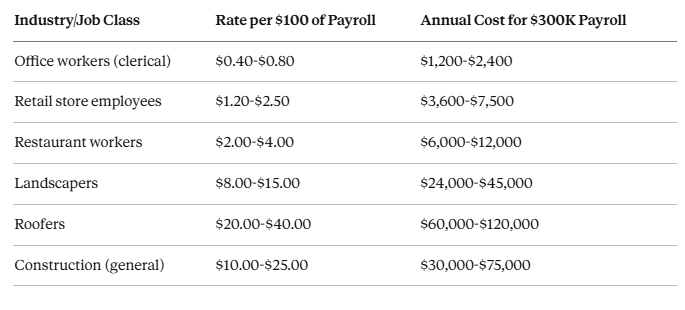
Industry Rate Examples (California 2026)
Key takeaway: Higher-risk industries pay significantly more.
Factors That Increase Cost
✅ High-risk industry (construction, roofing, manufacturing)
✅ Claims history (more claims = higher premiums)
✅ Poor safety record
✅ High employee turnover
✅ Misclassified job codes (if you classify roofers as office workers to save money, you'll face massive penalties and back premiums)
Factors That Reduce Cost
✅ Low claims history (3+ years claims-free)
✅ Safety programs (documented training, safety equipment)
✅ Experience modification factor below 1.0 (industry calculation of your claims vs. expected claims)
✅ Accurate job classifications
✅ Return-to-work programs (getting injured employees back to light duty ASAP reduces lost-time claims)
Penalties for Not Having Workers' Comp
California aggressively enforces workers' comp requirements.
Penalties if caught without coverage:
Civil Penalties:
$10,000 minimum fine (even if you have zero employees)
Up to $100,000 in fines
$1,500-$5,000 penalty per employee per day without coverage
Criminal Penalties:
Misdemeanor charges
Up to 1 year in jail
Additional fines up to $250,000
Personal Liability for Employee Injuries:
If an employee is injured and you don't have workers' comp, you're personally liable for all medical bills, lost wages, and damages
Employees can sue you directly (they normally can't sue if you have workers' comp)
No cap on damages
Stop Work Order:
The state can shut down your business until you obtain coverage
Real scenario: Cerritos restaurant owner operated for 2 years without workers' comp (4 employees). Employee suffered severe burn injury in the kitchen. Medical bills: $180,000. Lost wages: $45,000. Restaurant owner didn't have workers' comp.
Outcome:
Personally liable for $225,000 (no insurance to pay)
State fined him $85,000 for operating without workers' comp
Had to sell the restaurant to pay judgments and fines
Declared personal bankruptcy
The cost of workers' comp he was trying to avoid: $8,000/year.
How to Buy Workers' Compensation Insurance
Step 1: Gather Employee and Payroll Information
You'll need:
Total annual payroll
Number of employees
Job classifications for each employee
Business description
Step 2: Get Accurate Job Classifications
Workers' comp rates are based on job codes that describe what employees actually do.
Common mistakes:
Restaurant owner classifies cooks as "office workers" to get lower rates (fraud)
Contractor classifies all workers under one code instead of separating office staff from field workers
Action: Work with your agent to ensure accurate classifications.
Step 3: Shop Multiple Carriers
Workers' comp pricing varies significantly by carrier.
Options:
Standard admitted carriers (Hartford, Travelers, Zurich, Liberty Mutual)
State Fund (California's state-run workers' comp carrier—often the option of last resort for high-risk businesses)
Assigned Risk Pool (for businesses that can't get coverage elsewhere)
Shop at least 3 carriers or work with an independent agent who can compare multiple options.
Step 4: Implement Safety Programs
Carriers offer premium credits (5-15% discounts) for documented safety programs:
Employee safety training
Written safety policies
Personal protective equipment (PPE) requirements
Incident reporting procedures
Step 5: Purchase Policy and Stay Compliant
Once you buy coverage:
Post required workers' comp notice in the workplace (carrier provides this)
Train employees on how to report injuries
Report all injuries to your carrier immediately
Maintain accurate payroll records
How to Reduce Workers' Comp Costs
Strategy #1: Implement a Return-to-Work Program
Getting injured employees back to light-duty work ASAP reduces lost-time claims and premiums.
How it works:
Employee injures their back, can't do heavy lifting
Instead of full disability, they return to light-duty (answering phones, data entry, etc.)
Workers' comp pays partial disability instead of full disability
Employee heals while earning income, claim costs are lower
Savings: 20-40% reduction in claim costs
Strategy #2: Improve Workplace Safety
Fewer injuries = lower claims = lower premiums.
Actions:
Provide safety training
Supply proper safety equipment
Enforce safety policies
Conduct regular safety audits
Savings: 10-25% premium reduction over 3 years
Strategy #3: Manage Claims Proactively
Report all injuries immediately and work with your carrier to manage claims effectively.
Why this matters:
Delays in reporting increase claim costs
Early intervention reduces medical expenses
Proactive claims management improves your experience mod (the factor that affects future premiums)
Strategy #4: Audit Your Payroll Classifications Annually
As your business changes, job classifications may change. Ensure you're classified accurately—overpaying for wrong classifications is common.
Strategy #5: Shop Your Policy Every 2-3 Years
Workers' comp rates are competitive. Shopping carriers regularly ensures you're getting the best price.
Common Workers' Comp Mistakes California Employers Make
Mistake #1: Classifying Employees as Independent Contractors
Why employers do this: Avoid paying workers' comp and payroll taxes.
Why it's illegal: California has strict tests for independent contractor classification (AB5 and subsequent legislation).
Penalties:
Back premiums for all years you should have had coverage
Fines and penalties from the state
Personal liability for injuries to misclassified workers
Potential criminal charges
Mistake #2: Not Reporting Injuries Immediately
California law: Employers must report serious injuries within 5 days.
Why delays are costly:
Claim costs increase
State may penalize you for late reporting
Employee trust erodes
Mistake #3: Trying to Discourage Employees from Filing Claims
Illegal actions:
Threatening to fire employees who file claims
Offering cash payments to avoid filing
Retaliating against employees who file
Penalties:
Serious fines and penalties
Lawsuits for retaliation
Increased state scrutiny
Better approach: Focus on prevention and return-to-work programs, not discouraging legitimate claims.
Mistake #4: Not Posting Required Notices
California requires employers to post workers' comp notices in the workplace. Failure to post can result in fines.
Required posters:
Notice to Employees - Workers' Compensation Rights
Other state and federal labor law posters
Final Thoughts
Workers' compensation insurance isn't optional in California. If you have employees, you must have coverage—no exceptions.
The cost may seem high, but the penalties for non-compliance are catastrophic. And the right coverage protects both your employees and your business from financial disaster.
Need help with workers' compensation insurance?
📞 Call: (562) 402-1737
📧 Email: info@pinoygeneralinsurance.com
📍 Visit: 17304 Norwalk Blvd, Cerritos, CA 90703
🌐 Online: pinoygeneralinsurance.com
We'll help you:
Determine your exact workers' comp requirements
Get accurate job classifications
Compare quotes from multiple carriers
Implement safety programs that reduce premiums
Stay compliant with California law
Because protecting your employees shouldn't put your business at risk.
About the Author:
Felix Lopez is a licensed insurance agent and business development manager at Pinoy General Insurance Services in Cerritos, California. Since 1993, Pinoy General Insurance has been helping Orange County businesses protect their property, liability, and income through comprehensive commercial insurance solutions.
Contact Us Today
Contact us here at Pinoy General Insurance Services today for all your insurance needs.
Phone
© 2025 Pinoy General Insurance Services. All rights reserved.